Category Archives: Ask The Yentas

Ask The Yentas: Kipah & Ketubah Names

Recently, two very reasonable questions came my way and I thought they’d be great to share with all of Yentaland. These questions crossed my mind when I was planning my wedding as well, so I’m sure there will be readers who are looking for these answers as well.

First, a message from Melanie:
Hello Yentas!
I am so glad I finally found you! I am trying to order the yarmulkes and I have no clue what to write inside. I don’t live in my home town so I can’t go to the drawer with all of the old ones in it. So do personalize them with:

“The Wedding of Bride’s First and Last Name & Groom’s First and Last Name” or should I just use our first names?
What goes inside? Please and thank you!
Melanie

Answer from The Wedding Yentas:
Hi Melanie!
It’s really up to you when you personalize the inside of your yarmulkes! It’s a personal preference. For my own wedding, I just included The Wedding of Alison & Bryan with our wedding date underneath. While it’s not wrong to include last names, you might not want to take up extra space and clutter the area with the 2 additional names. Plus, by the time people take them home to re-wear them, you will no longer be known as your first name and maiden name (exciting, right?!) and you will both have the same last name (mazel!). So, my suggestion would be to keep it to the first names. Nothing’s right, nothing’s wrong. Personal preference and that’s mine.

You can also include your wedding date below the names. You can use the American calendar like I did — May 25, 2008 — or you can include the Hebrew month, day, and year. You’d need to check to make sure you have it correctly, but it just depends on how Jewish you want to make it.

Good luck!!
Alison

Great question, right? Melanie, I hope that helped you!

Next, another question about last names, but this time it’s in regards to the ketubah.
On Facebook, Megan asked:

Ok this may be a dumb question but do I sign the ketubah with my maiden name or married name??

Answer from The Wedding Yentas:
Not dumb!! Totally reasonable question. Since you sign the ketubah before your chuppah ceremony (which also serves as your official civil ceremony), you’ll autograph the ketubah with your maiden name. All ketubah signers, as well as marriage certificate signers, should use their full names, and that includes the bride and groom. If you have a Hebrew name, be prepared to know what it is and sign that as well. If your Hebrew is a little rough or non-existent, your rabbi should be able to help you write the letters. Always check with your officiant for specific directions.

So there you have it! Two totally reasonable questions with answers that hopefully help some fellow Yentas in distress.

If you have more questions, feel free to email them to alison @ theweddingyentas [dot] com and I’ll be happy to help you! I’m a geek, so I normally know the answer but if I don’t, I’ll find out for you. Consider The Wedding Yentas your personal wedding concierge!

Who Holds Your Wedding Rings?

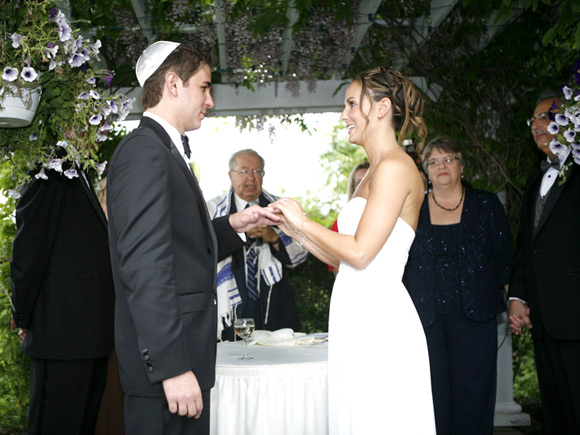
Sometimes it’s helpful to be a Facebook addict. Yesterday, I noticed that Lauren, who was a recent contributor to Tales from the Veil, posted a status that said she was unsure who should hold the rings during the wedding. Good question! Got me thinking that this question is a common one (I remember asking it while planning my own wedding) and it would be helpful to address it here on The Wedding Yentas. So don’t put yourself through the ringer and stress about the official ring holders! Here’s some food for thought.


(Photo by Beth Kesier Photography)

Pockets. It’s all about pockets. You may have cute little ring bearers, but don’t kid yourself that some kid is going to take ownership of the actual (and, ahem, expensive) rings. So who’s another candidate for possessing the rings? Pick a groomsman; most likely one will have pockets. And hopefully at least one will not be too hungover from the rehearsal dinner the night before. So, pick a responsible groomsman with pockets!

Does this designated groomsman only hold the groom’s ring? Well, unless an equally-responsible bridesmaid also has pockets, both bride and groom rings should probably go to the groomsman. If you are keeping Jewish tradition and accepting a ring that’s not adorned and solid all the way around for the ceremony, don’t forget to give this ring to the Heroic Groomsman as well. Essentially, he’ll be carrying three rings! Yes, so make sure his pockets are deep. And responsible.

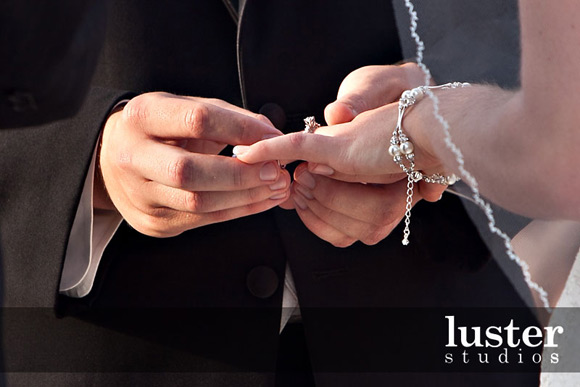
After you’ve exchanged your traditional rings, you may want to put on your non-traditional wedding band after the ceremony. That’s what I did and it worked like a charm. I couldn’t wait to skip away from the chuppah and finally wear the diamond band our best man had in his pocket. Like a moth to the flame went my ring to my finger. Ah yes, that’s it. Right there. Hits the spot.


(Photo by Luster Studios)

Once the pretty “every day ring” met its two new neighbors — the engagement ring and my finger — I removed the solid gold band that was used for symbolic purposes during the ceremony and gave it to the best man. So, make sure the groomsman you choose remains responsible (if just for a short while!) after the ceremony so that he can put the traditional ring somewhere safe that was agreed upon prior to the day’s hoopla. Once that open bar is ready for action, no groomsman — no matter how responsible! — can be trusted. So, the traditional ring needs to make it back to a secure home (bridal room, a purse under a chair, the wedding coordinator, etc.).

Bottomline: Just find someone you can count on, will be near the chuppah during the ceremony, and who has the ability to store and transport your bling. Groomsman or grandpa, it doesn’t really matter. Just make sure that in the midst of planning your centerpiece decor and must-have music playlist, you consider this easily-forgotten detail and put a plan in motion. Once you know how to handle the rings, you’re one step closer to ringing in your new, married life!

Ask The Yentas: Edition #2 – The Chair Scare

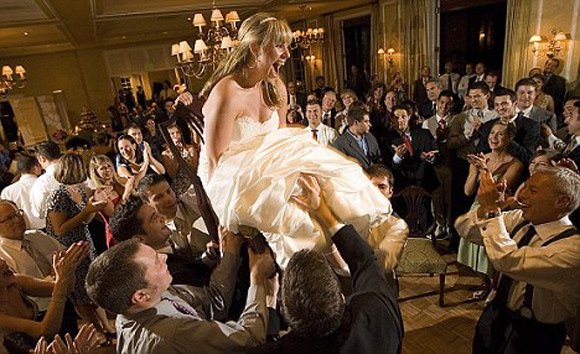
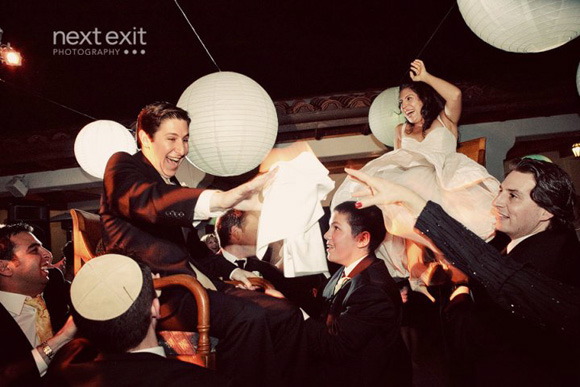
The Chair Scare: The feeling of butterflies about going up in a chair a handful of feet above the ground while holding onto a napkin, grinning with clenched teeth through the tight corset of the wedding dress during a series of bounces and hollers from the crowd.

Sound fun?

It doesn’t have to be scary. The tradition of going up in the chair is a festive and fun part of the reception’s Hora dance and we’ve received questions about how to get over the fear of this custom.

Dear Yentas,
My wedding is around the corner, and everyone tells me that the fun part is the reception where my soon-to-be husband and I will go up in the chair. I’m afraid of heights. I hate roller coasters. What if I drop the napkin? What if I fall off the chair? I don’t want to break any rules, and I’d like to get over my fear, but maybe I can just avoid it altogether. What do you think?
Thanks,
Elise
Tampa, Florida

Elise, and all others who are feeling under the weather with The Chair Scare,
This is supposed to be a fun tradition and definitely not something that causes you stress. First, make sure that your venue or wedding coordinator set aside two arm chairs for you. There should be two chairs with arms. Make sure the chairs have arms. You should use arm chairs. Is the point clear? This gives you something to hold on to and provides your body with boundaries as you become (lightly) jostled around.

the-hora-chair-lift

Also, there are no rules! Just hop in the chair, hold on, and enjoy the ride. Someone will probably toss you a napkin to hold with your new partner and if you drop it through all the excitement – meh! – so what! The napkin isn’t a Torah; it’s okay if it falls. Many couples do and they lived happily ever after.

Before you plop down on the chair, remember to do a quick smooth-out on the tushie part of your dress. That way, if you have any beading or details on your dress, you won’t be uncomfortable from getting them lodged in nooks and crannies when you sit on them. The more comfortable you are, the more you can relax, and the less afraid you’ll be. See? It all comes full circle.

If you’re wearing a short dress or a tea length dress, cross your legs at the ankles. You are a married woman for goodness sake! You don’t want all those eligible bachelors to get a free show! Be a lady and make sure the tops of your feet touch each other.

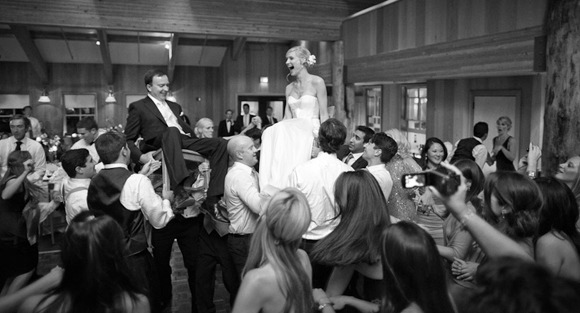
image-courtesy-of-michael-tallman

You don’t have to stop eating for 2 weeks before the wedding. Give some strong men a heads up about the chair lift portion of the Hora and they’ll carry you like you’re Tinkerbell. Do not be afraid of being dropped. With four legs on the chair and at least one man per leg, it’ll be easily for the strong men to balance you. Perhaps in the days leading up to the wedding, call some of the men you’d like to be your chair lifters and give them advance warning that they’ll have this duty at your reception. That way, you can relax knowing that this very important task is handled and you don’t have to worry about it during your ketubah signing, aisle walk, circles, wine blessings, photos, and shmoozing that all take place during the Wedding Olympics.

Remember, the Hora is a joyous and happy part of the wedding reception. So as you are six feet off the ground and literally high on life, look at your husband who is up there with you and know that together you’re on top of the world. Then, look down, and enjoy all of your favorite people singing and clapping and loving you right back.

Love,
Alison & Nicky
The Wedding Yentas

the-hora-chair-lift