Category Archives: From the Expert

Wedding Advice From A Seasoned Mother of the Bride & Groom

ellenAs the mother of the groom five years ago and mother of the bride one year ago, Ellen has had in-depth experiences celebrating wonderful simchas. With this experience, she has cultivated wisdom about being a mother along for this wedding ride, and is happy to share her lessons with fellow Yentas!

I’ve been the mother of a bride and the mother of a groom! They are both wonderful things to be, but can be very different experiences, but it’s all about how you handle and choose to see them. I was the groom’s mother first, and although I never searched extensively for information about the etiquette or what’s involved in being the mother of the groom in terms of planning a wedding, I did do some reading, and first and foremost used my instincts.

Let’s face it, we mothers are all females first, and as such, we should understand how important weddings can be particularly to our fellow females! So, the first thing I did was put myself in my future daughter-in-law’s place. I knew that I would have wanted to make my own decisions regarding my own wedding, so I let her and my son plan the wedding of their dreams.

Of course there are factors to take into consideration depending on the families’ payment and hosting philosophies. Budget plays an important part in the planning of a wedding and everyone knows that the more money you have to spend, the more options you have. Here’s my thing, and I feel very strongly about it: Single-sided payment or hosting is a thing of the past in my eyes. The tradition of having the bride’s parents pay for the majority of the wedding dates back to the time of the dowry system. This custom began out of a desire to get the bride’s family to contribute a share of the costs involved in setting up a new household. For me, this is an antiquated tradition that really doesn’t apply to modern society. I found that working with the bride’s family and setting up an equal and fair budget that worked for both families took the pressure off of the engaged couple and gave everyone a voice in the decision-making.

The point is, if you’re involved financially, then it’s always nice for the “kids” to take your opinions into consideration, but just because that’s nice, doesn’t mean you should demand your opinions be heard. If you’re contributing with cash, it’s more than likely because it’s out of the goodness of your heart anyway, and you want for your kids to have a wedding day that’s in line with their vision.

I also trusted my son and his fiancée. They were certainly capable of making intelligent decisions about what they wanted on their day. In other words, as the mother of the groom, I basically chose to, for the most part, butt out! My husband and I were lucky in that my son and future daughter-in-law were great about including us in what their ultimate decisions were, and asked for our “OK” before we put any deposits down or paid for anything.
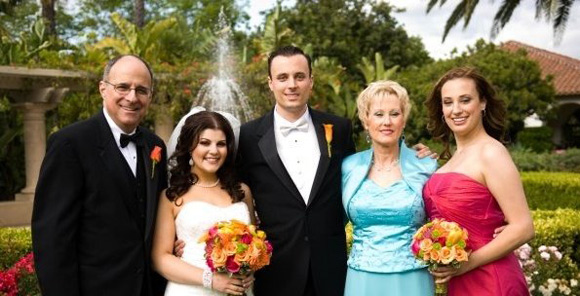
Photo by Eight20 Photography

Photo by Eight20 Photography

I think, though, that in part, this was because we never forced our opinions on them. They were free to make their own choices and just do a “double-check” with us. It made for such a smooth planning process and ultimately a spectacular wedding. As the mother of the groom — or bride! — it’s important to realize that the choices may not be exactly what you want, but it’s not your wedding.

MOGS, take it from me; the less you say, the better. You already had your day, and even if you might have missed out, your children’s wedding is not the time for you to try to have it vicariously through them. While I don’t suggest you do the old fashioned MOG behavior of “wear beige and shut up”, I encourage you to ask questions, be supportive, and ask “how can I help”? Trust me!

And by the way, followed my own advice when I was the mother of the bride as well. I was as supportive as I could be without being pushy, and it worked again! Find that middle ground! And mazel tov!
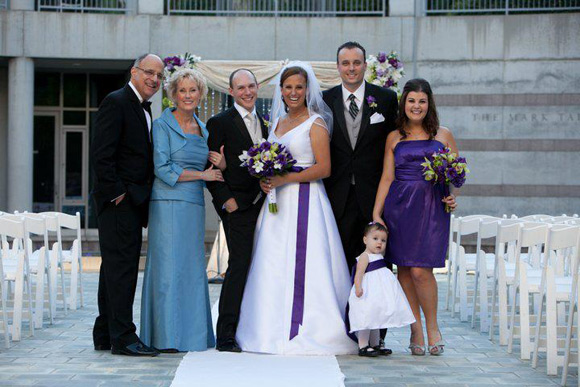
Photo by ES Photo

Photo by ES Photo

Behind The Scenes of a Custom Ketubah

From-The-Expert
By Anna Abramzon of Anna Abramzon Studio

Eric and Jessica found my art when they were searching for a ketubah and came across my Etsy shop. They liked my style, but were looking for something totally original for their upcoming wedding. They were developing a movement/dance theme for the big day (and their life in general) and liked the idea of having a completely unique hand painted ketubah that no other couple in the world would have.

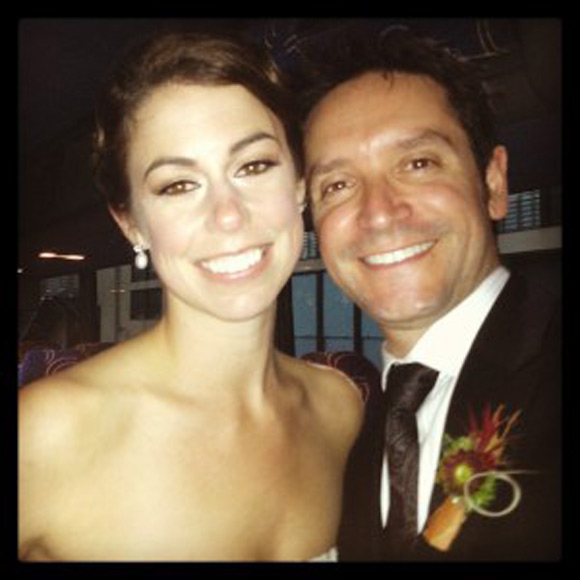
This is Eric and Jessica, how cute are they?

Anna Abramzon Studio

And so began our journey together. My favorite thing about painting custom ketubot is the opportunity to get to know the couple. Although I have never met Eric or Jessica face to face (they are in San Francisco while I am in Houston) I really loved getting to know them and their creative vision through phone calls, and countless emails.

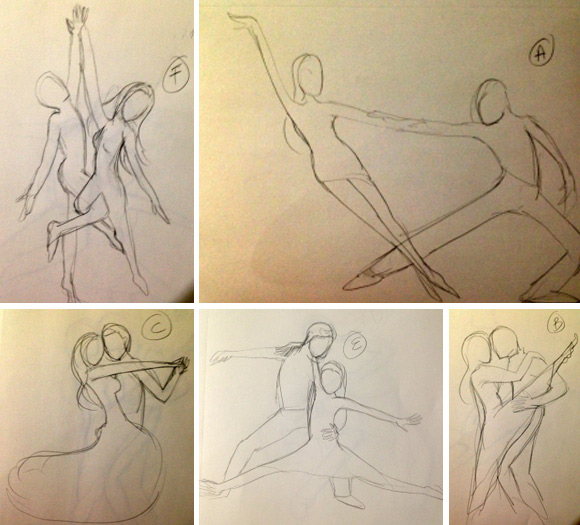
We started out by brainstorming ideas. I asked them to send me imagery that was appealing and meaningful to them so I could get a feel for their aesthetic. Since they knew for sure that they wanted a dancing figure on the ketubah, I started out by sketching a whole bunch of dancing figures for them, to see what they would like so we could go from there.

Anna Abramzon Studio

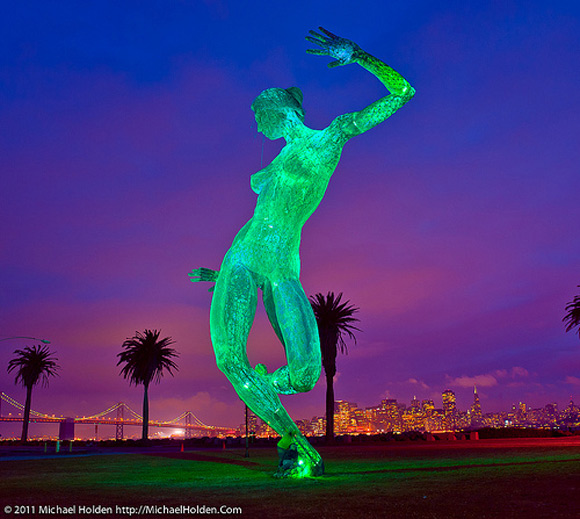
But these were a little too “Dancing with the Stars” for them. They sent me some images of the kind of dancing they were into, including this amazing sculpture called Bliss Dance from Treasure Island in San Francisco. Their wedding ceremony would be right next to it.

Treasure Island

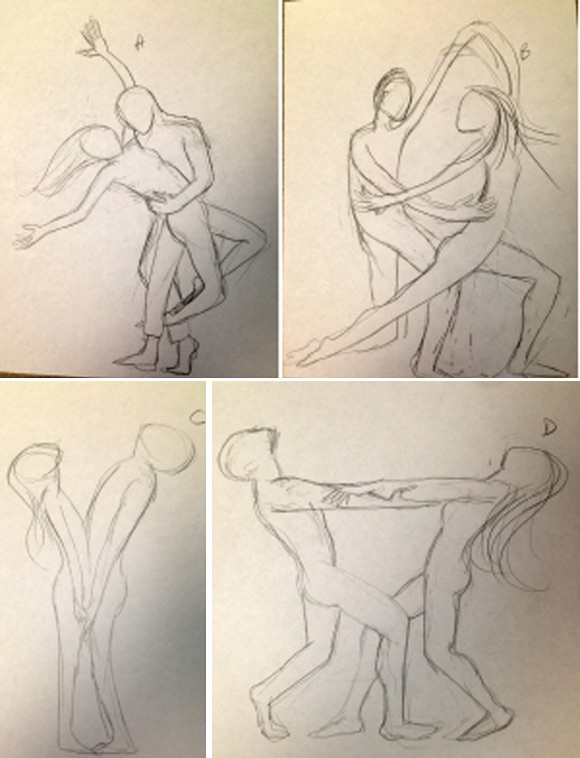
So back to the drawing board I went! I presented them with a new series of sketches, focusing on a more organic, flowing and energetic dance style:

Anna Abramzon Studio

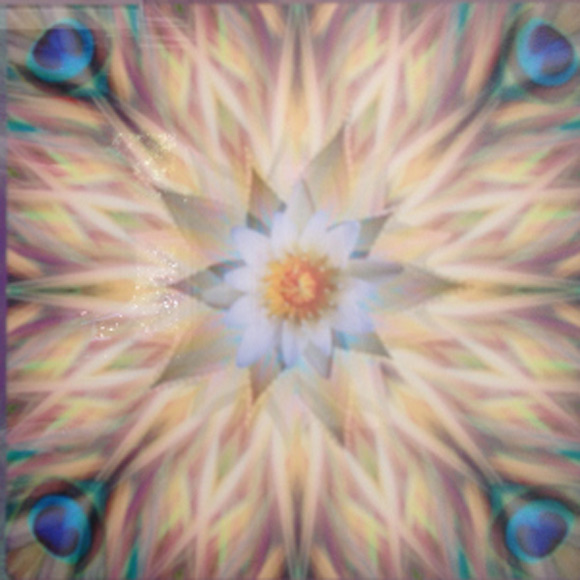
And we had a winner! They liked sketch C. They also sent me an image they really loved from a meditation retreat they had just attended, for inspiration. Yes, this wonder couple has time to plan a wedding, study for bar exams, and attend meditation retreats, too!

meditation

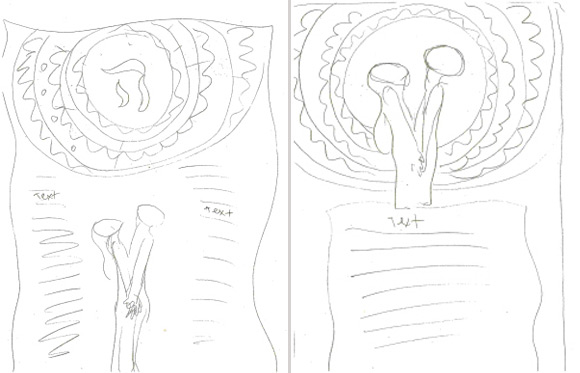
Next I presented them with a few layout ideas, one with the text split and one with the text all together:

Anna Abramzon Studio

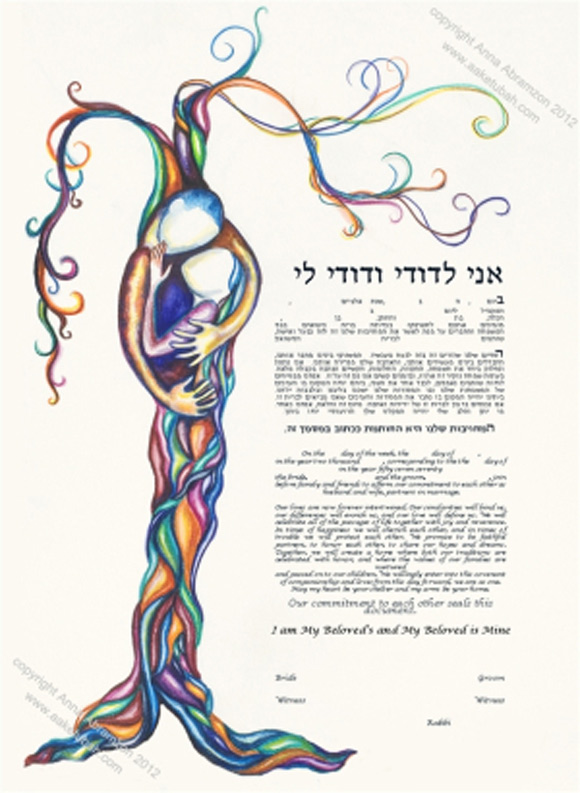
They chose the split-text layout and decided against a “chai” on the top. They also told me they liked the rendering style from the Love Tree 2 Ketubah.

Anna Abramzon Studio

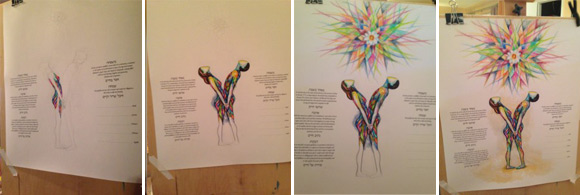
It was time for my favorite part, painting!!

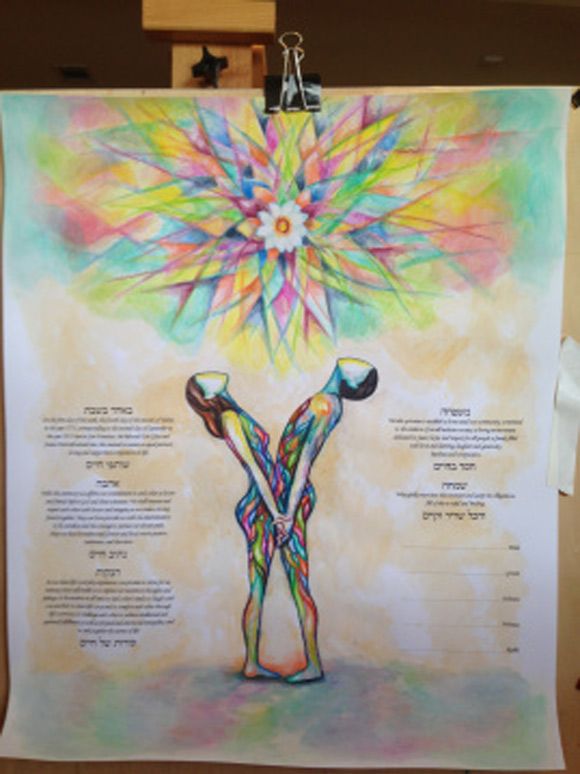
Anna Abramzon Studio

Drumroll please…..

Anna Abramzon Studio

Just a few sentimental sniffles at the FEDEX office, and off the ketubah went on its journey to California and to its permanent home with Eric and Jessica!! Mazel tov you guys!!!!

Thank you so much, Eric and Jessica, for letting my art be a part of your special day. It was truly an honor! May your ketubah stay with you for a long, fulfilling and inspiring marriage, full of miracles! L’Chaim!

***********************************

Anna Abramzon StudioToday, Anna Abramzon of Anna Abramzon Studio chimes in as a ketubah expert on The Wedding Yentas! They say she started drawing before she started walking, but that may be an exaggeration. As soon as she did start walking though, Anna started traveling, sketchbook in hand. She has lived all over the place and her travels have infused her artwork with color and life. Anna specialize in mixed media, combining collage with gouache, watercolor, pencil and ink. Anna met and married her husband in Jerusalem, Israel, and thought their wedding was a wonderful opportunity to create some love-inspired art, so she painted their ketubah, their invites, their thank you notes, and pretty much everything else that she possibly could for their wedding. Next thing she knew, other people started asking her to create artwork for their weddings. And that’s how Anna became a ketubah artist. She lives in Houston, Texas with her husband and daughter. Shop for your ketubah and keepsake art at Anna Abramzon Studio.

Wedding Dress Shopping: A Fruity Approach

From-The-Expert

It’s so exciting to have an expert in the house! When it comes to dresses, Mill Crest Vintage knows their stuff! Personally, I’ve always loved antiques and historical items. I may not be a mathematician (when I hear “pi” I think pumpkin and apple), but I do know this: vintage styles + wedding = gorgeous! Today, Mill Crest Vintage is on board to tell us all about which kinds of dresses should go on various body types. Paula Cooperman, owner of Mill Crest Vintage, has spent three decades hand selecting each piece to add to her amazing collection of vintage bridal wear for both the traditional and non traditional bride, so she really knows about the potpourri of styles out there — from vintage to new — that do a body good! She has an amazing eye for detail and a great passion for finding what makes a woman feel the most beautiful on her wedding day. Offering personal and private bridal consultations in her Lambertville, New Jersey bridal salon, Paula has had the opportunity to work with hundreds of brides, gaining both experience and expertise in what goes into selecting a vintage wedding dresses and vintage bridesmaid dresses.

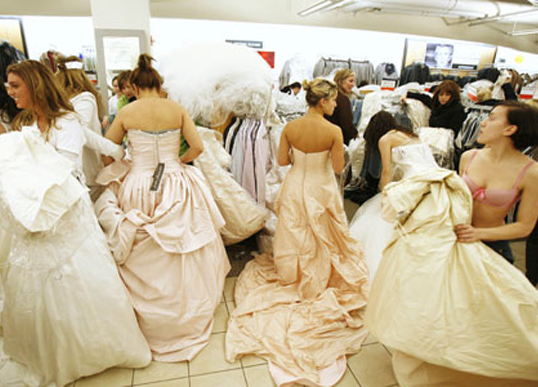
So the big day is almost here and you are now on the hunt for your wedding dress. You’ve scoured the magazines, surfed the web, and perhaps even taken pen to paper with your own designs in mind. Still, you have yet to find the dress that balances your (since you were 12 years old with a towel on your head running around the house singing “Here Comes The Bride”) dress of your dreams expectations, with the reality of your figure. While some very lucky gals out there can truly wear just about anything, the other 99% of us didn’t quite get the luck of the draw. Truth be told, it is not the size that matters (insert joke here) but instead, the shape. Yes lovelies, no matter what the scale says, figuring out one’s shape is much more important than one’s actual size. I hear ya! It’s about time someone finally focused on something other than the scale.

Seriously though, there is a good reason for all of this “figure out your figure” talk. The idea is to create the illusion of balance between the shoulder and the hip. Truthfully, this should be the ultimate goal for any woman when considering any dress. By determining one’s shape, a woman can determine which style of dress will balance out her figure best.

Here’s what we’re analyzing: pears, apples and squashes (yes, evidently squash is a fruit. Who knew?)

Ok, doll, time to get in front of a mirror and give yourself a good once over. Ask yourself: Am I shaped more like a pear (wider at the bottom than on the top)? How about an apple shape (wider in the middle than on top or bottom)? Perhaps I am shaped more like a squash (hourglass shaped)? Determining which fruit you most resemble will be the biggest and most important step in choosing the perfect dress.

For you pear shaped gals, stick with A-line dresses, as well as, halter style dresses. A-line dresses look great on the pear shaped figure because the A-line dress is narrow at the top and flares gently at the base thus, drawing attention to the upper body, shoulders, and neck while disguising the wider hips and thighs. The halter top style dresses look great on a pear shaped body, too, especially because the desire is to flatter the bust and draw attention away from the problem area (the wider hip). Choose a halter style dress that nips in at the waist, and flares out into a wider skirt. Dresses with thin straps or one-asymmetrical shoulder also look great on the pear shaped figure. This allows the dress to drape over the body in such a way that the shoulder line and hip become more symmetrical with one another. Using detail at the shoulders and/or at the bust line helps to further balance the hip-to-shoulder ratio, giving the illusion of a minimized hip and a more hourglass shape.

For all the pears out there: There are also a few what-not-to-do recommendations. Considering the two styles of dresses recommended, pear shaped women should still avoid busy patterns and embellishments throughout the entire dress and instead opt for embellishments only in the bodice. Beads, ribbons, ruffles, and other decorations on the bust of a form fitting bodice should be chosen over embellishments in the skirt. Avoid tops that have narrow v-necks, heavily-gathered necklines, dolman sleeves and raglan sleeves, which can all reduce the width of your shoulders.

Ok apples, you’re up! For our yummy apple figured gals, empire waistlines are highly recommended. An empire dress in the right material works well to elongate the body, drawing attention away from the midsection, while still managing to show off the good curves. This style narrows at the top and flares slightly as it cascades toward the bottom, which is why it is flattering for apple figures. Choose a material like cotton or cotton blends, which will skim the body’s silhouette, and go for monochromatic color schemes. The illusion of the empire waist line enhances the curves of the bust and hip in such a way that balance is achieved, while the proper draping and the monochromatic color scheme offer a streamlined effect.

As we discussed, the benefit of an empire style dress for apple shaped figures is that it camouflages the midsection offering a slimming effect. However, there are a few things to avoid, such as ruffled shoulders or shoulders with padding. Do not wear dresses that feature a lot of busy detail especially near the waist, like ruffles, ruching, or other embellishments. This calls attention to the midsection, which is the area apple shapes usually try to minimize focus. Also, avoid any rounded flower corsages and instead opt for a corsage with cascading effects.

Finally we have arrived at our squashed shaped ladies. Apologies for referring to this sort of shape as a squash, but it is truly the only hourglass shaped fruit we could find. Hey, squash could have been easily swapped for gourd. But no woman I know would like to be referred to as a gourd. Moving on… As you may have guessed, women with ample bosoms and hips to match are considered hourglass shaped, like a squash. For this figure type, we recommend going with an A-line dress or a wrap dress, as long as the fabric drapes over the curves of the body without cinching or hugging. The idea is not exactly to reduce size, but instead to enhance the curves and achieve overall balance. These two styles of dress work best for this figure type because both of them cinch at the waist, while revealing the already balanced ratio between bust and hip. In other words, these two styles of dress complement the curves of the curvy hourglass shaped woman. For more full figured hourglass shaped gals, we also recommend V-cut necklines and some sleeve, even if only capped, to conceal any spill over from the bust.

Some don’ts for our beautiful squashes include dresses with a straight style and sleeveless dresses. Also, as some of us know, larger arms sometimes accompany a larger bust-line. Adornments and embellishments are fine, but avoid any at the arms, because too much “bling” at the arm can add width and throw off the balance of the body. On a side note, please be sure to wear a proper-fitting plus-size bra that gives the breasts optimal support when wearing any style.

Follow these guidelines and your Jewish wedding will star a beautiful bride in the most perfect dress!

So there it is in nutshell (wait… nuts?). Sorry. There it is in a fruit bowl: The fruity approach to wedding dress shopping.

How To Write Your Own Ketubah Text For Your Jewish Wedding

From-The-Expert
By Anna Abramzon of Anna Abramzon Studio

Ketubah text has been a hot topic lately, with the custom of a ketubah (or a decorative marital contract) becoming more and more popular among couples from all different backgrounds and faiths. A good way to think about your ketubah is as a “marriage” between visual art and written word. So, you found the perfect art that speaks to you, but what next? If you are getting married with an Orthodox or Conservative rabbi then the choice is easy, at least for the Hebrew portion of your ketubah — there is a standard Orthodox Aramaic text and what is known as the Conservative text with Lieberman Clause. If you have a rabbi from one of the more liberal movements then you have more decisions to make. Either way, most rabbis don’t mind if you pair the Hebrew or Aramaic with an English text of your choice, especially because the Orthodox and Conservative texts are pretty cut and dry. Ketubah websites and shops usually have a variety of texts for you to choose from, but what if none of them fully express what you want to say to each other? After all, it’s a very personal conversation between you and your fiancé!

Here are some tips for writing your own ketubah text:

The Basics:

A ketubah is a contract, so there is some information that it traditionally includes:

The date of the week of the wedding — if you are having the ceremony on a Saturday before sunset, some rabbis prefer that you list your wedding as Sunday so you are not getting married on Shabbat. This is something to check with your officiant.

The English date of the wedding

The Hebrew date of the wedding: remember, Hebrew days start at sunset, so if your chuppah is after sunset then you should list the next day’s Hebrew date. Here is a great site that will convert the date for you.

The location of the wedding: Definitely the city and state, some rabbis also like to add the country.

Your names and your parents’ names: traditionally the names are written in this form: “Jennifer daughter of Jacob and Elizabeth/Sam son of Michael and Rachel.” Of course whether or not you want to include the parents’ names is ultimately a decision for you and your rabbi. Most Orthodox rabbis prefer to just have the fathers’ names, while Conservative rabbis are often times more open to including both parents’ names.

A sample first paragraph of a ketubah text:

On the _________ day of the week, the _________ day of the month of _____________, corresponding to the __________ day of the month of ______________ in the year _________________, here in __________, ____________, the bride ________________ daughter of ____________ and ____________, and the groom ______________ son of _______________ and _____________, come together before family and friends to affirm their commitment to one another as partners in marriage.

Now the fun part:

Think of ketubah text as vows you are making to each other. A good way to get started is to brainstorm your values as a couple. Some good starting points: respect, kindness, support, love, faith, nurture. Do you plan to have kids? You can include some values for raising children, such as “we will pass on our values to our children”.

Don’t be afraid to get personal. Want your partner to bring you a glass of water before bed every night? Here’s your chance to get it in writing!

It’s OK to be funny. Some amazing clients of mine wrote a truly unique ketubah text that included that the bride “always gets a maid.” and “In return the (groom) will always have a microwave (lest he find himself stirring his oatmeal over an electric stove like some early-American pioneer);” Another favorite of mine was a couple who were both teachers and ended their text with “I vow to always be your greatest teacher.” Remember, that humor is never bad for a relationship and is as old a Jewish value as the 10 commandments. 😉

You can write the paragraphs as vows you are saying to each other:

“The bride and groom declared to one another: ….”

Or divide them:

“The bride, _______, said to the groom_________: ….”

“And the Groom,__________, promised his bride__________: …”

Be true to your spirituality: If religion is an important part of your lives, then by all means include that in your text. You can draw on biblical passages, or mention conditioning ancient traditions. But if religion is not your thing, then don’t feel pressured to mention it. This is your ketubah and it should reflect who you are as a couple.

Ask for help: If you get stumped, ask for help! Studying others’ ketubah texts can help you get ideas, but your rabbi, officiant, or ketubah artist could also be great resources. Remember, they deal with ketubahs all day long and you can’t beat that kind of experience!

Make it meaningful: When my husband and I were getting married, our rabbi said to us that engagement is like a microcosm of the rest of your lives together. You deal with all the big issues: budget, family, personal taste, etc., at once. Your ketubah text is a great opportunity to start a conversation and set a precedent for how you will work together as a couple.

Don’t forget to proof read: Because wouldn’t you hate to stare at a typo on your wall for the rest of your lives?

Enjoy the journey. Remember, your ketubah will stay with you forever, so let this process be a wonderful memory that accompanies you both into old age. Mazel tov!

AA1

***********************************

Anna Abramzon StudioToday, Anna Abramzon of Anna Abramzon Studio chimes in as a ketubah expert on The Wedding Yentas! They say she started drawing before she started walking, but that may be an exaggeration. As soon as she did start walking though, Anna started traveling, sketchbook in hand. She has lived all over the place and her travels have infused her artwork with color and life. Anna specialize in mixed media, combining collage with gouache, watercolor, pencil and ink. Anna met and married her husband in Jerusalem, Israel, and thought their wedding was a wonderful opportunity to create some love-inspired art, so she painted their ketubah, their invites, their thank you notes, and pretty much everything else that she possibly could for their wedding. Next thing she knew, other people started asking her to create artwork for their weddings. And that’s how Anna became a ketubah artist. She lives in Houston, Texas with her husband and daughter. Shop for your ketubah and keepsake art at Anna Abramzon Studio.

From The Expert: Understanding Your Options for Wedding Invitations

Fla-de-Dahs is a custom design studio and a recent winner of Special Events Magazine’s coveted “Best Invitation” award. Fla-de-Dahs has been creating one-of-a-kind invitations since 2001. While our main focus is custom invitations, we also carry several unique, high quality, ready-made invitations that cannot be found anywhere else. Fla-de-Dahs produces all projects in-house to ensure that the client receives the highest level of quality with each piece being hand-crafted and supervised by an expert production team. Each project begins with a complimentary personal design consultation. Once the client chooses a design, a complete sample will be presented for the client to review and approve before production begins. Make sure to “like” Fla-de-Dahs on Facebook and if you’re a Southern California local, visit their beautiful studio.

****************************************

Before you can make your decisions about wedding invitations, you’ll probably ask yourself: which is best for you — custom, DIY, or online?

??Before we look into the question of which is right for you, first consider that the invitation you choose is the first glimpse of what people will see and know about your event. It will set the tone and is truly the “front door to you event.” Custom isn’t right for everyone, but for many, it is the choice that can assure you that your event is one not to be missed.

DIY Perks:
If you are pretty creative and crafty, then this option can be cost-saving and fun, too. You can get friends and family involved and this could end up being a fun project that can create some nice memories.
DIY Disadvantages:
Choosing paper and embellishments can be daunting for those who don’t have an eye for this type of creativity and if you simply want to save money, this is not the choice for you. Knowing which paper to choose, how to cut it, how to print on it, how to embellish it and which tools are necessary to accomplish all of this may not be worth the time for the amount of money you may save.

Choose DIY if you are creative and have the time to spend and the tools to make your own invitations.

Online Perks:
They are usually less expensive and because of the vast catalog available online, you will most likely find the style that you’re looking for. Most can be modified to incorporate your colors and some even offer minor types of embellishments.
Online Disadvantages: Because you haven’t seen it, you can’t be sure of the quality of the materials. Sometimes, the samples fall short of the image presented online. You may end up wasting some time waiting for a sample only to find that it is not the quality you were expecting. Most of the time you need to buy in groups of 25, so there may be some waste.

Choose online if you are looking for a low cost invitation that can be made fairly quickly.

Custom Perks:
Since you are creating the invitation based on your unique style and taste, your invitation will be unlike anyone else’s. No one will have seen it online, or worse, received it for another event. This allows you to create your own brand for your event and can be carried throughout with all of your wedding accessories, including programs, escort cards, etc.
Custom Disadvantages: Most often, they are more expensive.

Choose custom if you are looking for a unique invitation that captures the essence of your event that no one else will have.

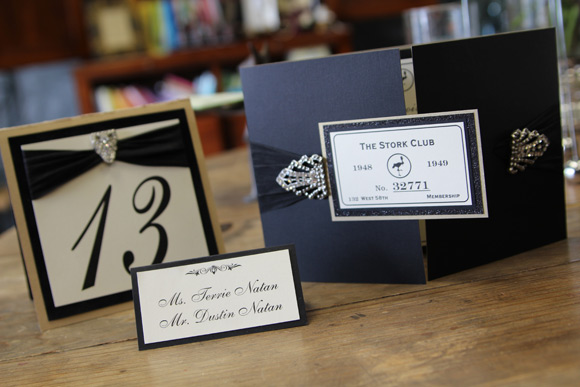
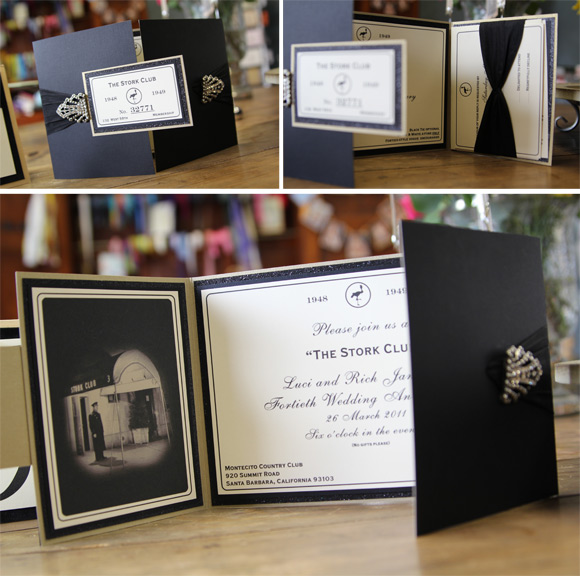
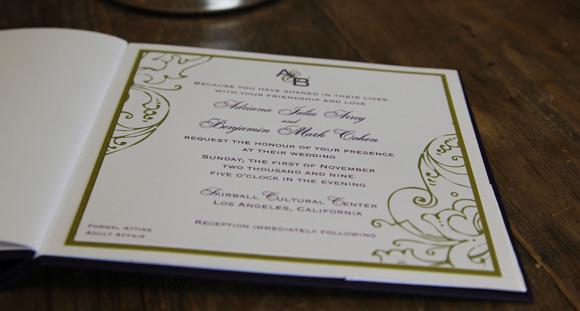
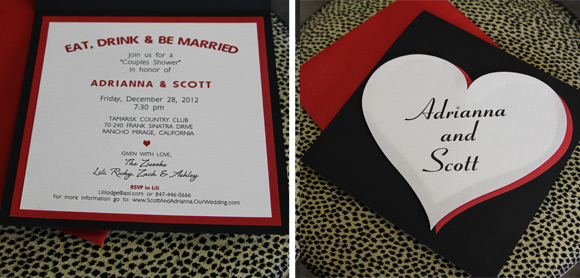
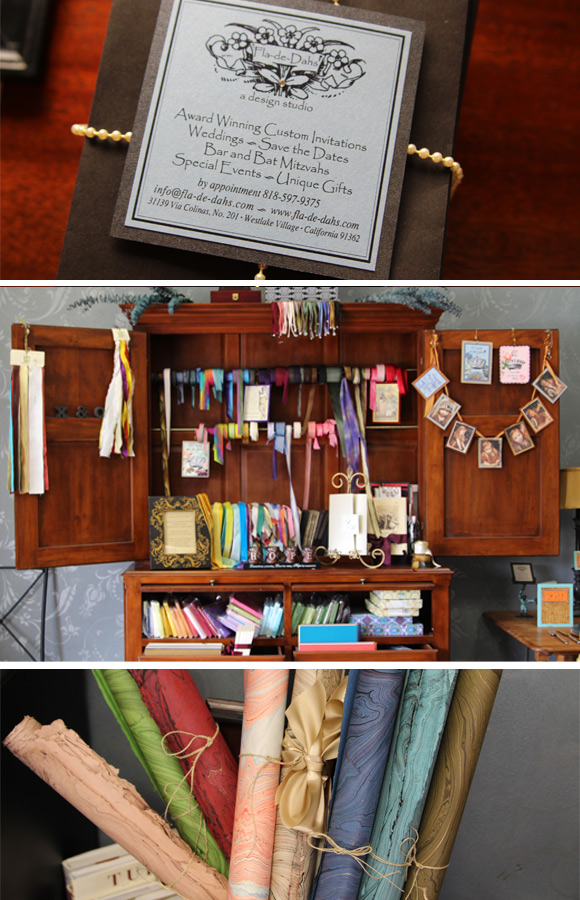
The gorgeous Flah-de-Dahs Southern California studio is home to the finest papers and stylized embellishments. It’s a kid-in-a-candy-store experience to touch and see the in-house products, and below you can see some photographic samples of such delicate, detailed, and intricate custom pieces!

Custom Wedding Invitations

FLD2

FLD3

FLD5

FLD6

FLD7

FLD8

FLD9

FLD10

FLD11