Over the course of almost three years, The Wedding Yentas has written extensive articles with your Jewish wedding in mind. Among these articles have been tips about signing with specific ketubah pens, what to drink under the chuppah, what kinds of chairs you should sit on during the Horah chair lifts, and more. Unfortunately, below the hundreds of beautiful Real Weddings, fun giveaways, and Tales From the Veil posts from real brides, some of these iconic pieces of Jewish wedding advice have been buried.
I was with some friends at a Jewish wedding last week and we were talking about certain traditions. “Didn’t you write something on The Wedding Yentas about that?” they’d ask. “Yes, but it was probably over two years ago,” I’d answer. And so it was decided I should unearth these gems and put them in one post so that you could easily read them.
So, here they are! Jewish wedding tips at your fingertips!
Who can sign the ketubah?
Every ketubah must be signed by two witnesses and these people can double dip their honors by being part of your wedding party or they can be two entirely different people. According to Jewish law, the two ketubah signers must be Jewish and unrelated to the couple by blood (sisters and brothers-in-law are technically allowed to sign). Depending on the ketubah text and the couple’s Jewish affiliation, the ketubah signers will most likely sign their names in Hebrew. Give your witnesses advance notice to find out their Hebrew names so they can bring them to the ceremony. The rabbi can also help them write their names in Hebrew if they need help. After all, it’s probably been a while since their bar or bat mitzvah!
What is “yichud?”
The yichud translates in Hebrew to the word seclusion. Traditionally, unmarried men and women should never be secluded together so, in theory, the wedding day is the first time this ever happens between the bride and groom. This law came about after the rape of King David’s daughter when she was left alone with her half brother. It was then that David and his high court extended this prohibition to all unmarried girls. Typically, the laws of yichud are followed by Orthodox Jews but all Jews may interpret the laws to fit their ceremony or beliefs. In early historical times, the yichud was when the just-married couple would consummate the marriage and witnesses would be there to guarantee privacy and verify that it indeed happened because technically, this was a legal and required act.
Fast forward to 2012. Modern day traditional brides and grooms leave the chuppah and go directly to a private area or room for their yichud. For couples who chose to fast on their wedding day in order to start their life anew, this is when they would also break the fast and exchange gifts. Typically, the bride will bless the groom, saying “May you merit to have a long life, and to unite with me in love from now until eternity. May I merit to dwell with you forever.” This is a recommended event on your wedding day as it gives you both a chance to catch your breath, relax, and enjoy your first moments as newlyweds.
How does the groom get a good crunch when he breaks the glass?
At the end of the ceremony, a glass is placed under the groom’s foot and he stomps on it. Word to the wise that our own wedding coordinator reminded my husband: Use your heel!! You’ll get a louder crunch and you’ll prevent any accidents. Also, include a lightbulb in the bag. Whether you choose to use keepsake glass (typically, colored glass that you can repurpose as a memento) or not, still shove a lightbulb in there (separate it in a plastic baggie if you’re also using keepsake glass). The crunch will be quite satisfying!
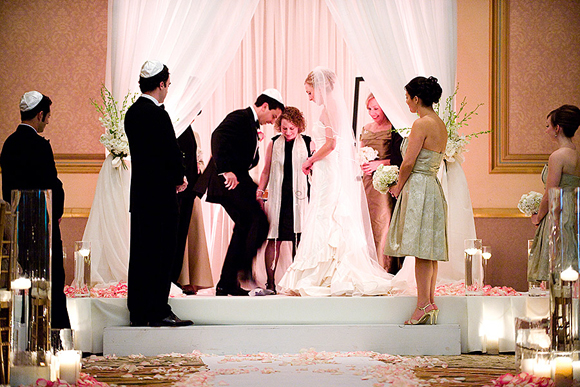
Scott and Tem Photography
What’s the purpose of the chuppah?
The chuppah is a canopy that symbolizes the home that the bride and groom will build together. The chuppah is open on all sides, also symbolizing that friends and family are always welcome in the newlyweds’ home.
What pen should I use during the ketubah signing?
Avoid pens that feather or bleed. You also want to be certain that your ink won’t fade over time, even if your ketubah soaks up sunlight and UV light. Waterproof pens are also a good idea because someone in your family will be crying tears of joy (I have my money down on a mom). Therefore, you should make sure to use an archival pigment ink pen, which you can find at any framing or art store.As you sign your ketubah, be sure the ink has dried before wrapping or rolling it up. You’d hate to smear your document! And never, ever use a felt tip pen like a Sharpie because it will bleed into the paper and potentially damage any art on your ketubah.
How should I personalize my yarmulkes?
There’s no rule here. For my own wedding, I just included The Wedding of Alison & Bryan with our wedding date underneath. While it’s not wrong to include last names, you might not want to take up extra space and clutter the area with the 2 additional names. Plus, by the time people take them home to re-wear them, you will no longer be known as your first name and maiden name (exciting, right?!) and you will both have the same last name (mazel!). So, my suggestion would be to keep it to the first names. Nothing’s right, nothing’s wrong. Personal preference and that’s mine.
You can also include your wedding date below the names. You can use the American calendar like I did — May 25, 2008 — or you can include the Hebrew month, day, and year. You’d need to check to make sure you have it correctly, but it just depends on how Jewish you want to make it.
What kind of ring should be used in the ceremony?
Jewish law says that a marriage becomes official when the groom gives his bride something valuable and that’s typically a ring. The rabbis say that it should be made of plain gold, with no blemishes, ornaments, or breaks in the ring. The continuity of the ring promotes the hope for an everlasting marriage and the lack of ornaments (read: diamonds. Yes, diamonds) signifies the simple beauty that comes from marriage. Jewish law requires that only the groom gives a ring to the bride, but many modern couples choose to exchange rings. While Christianity says the left finger is closest to the heart, the Talmud says that it’s the right forefinger that is closest to the heart. The next time a priest and a rabbi are in a bar, they can duke that one out.
So now you know the details of the ring’s appearance and important fingers according to Jewish law. But, wait, let me guess: you’re a modern bride and you already bought your icy wedding band and you’ve perfectly manicured your left fourth finger. Borrow a solid gold band from a family member or friend and use it in the ceremony. Have your best man (who, most likely, was already carrying the ceremony rings) hold onto the “real life” wedding band and you can slip that on after the ceremony so you can party in it.
What kind of wine should we drink under the chuppah?
When you think of Kosher wine, you probably picture it to be red. But there is white Kosher wine that’s totally legit and absolutely delicious and, most importantly, it won’t STAIN YOUR WHITE EXPENSIVE DRESS if it drips or splatters during the ceremony. You really won’t regret this decision and I hear couples ask all the time, “Why didn’t I think of that?” Well, now you have!
During the Horah, what kind of chairs should we be lifted in?
If you are feeling The Chair Scare, hopefully you’ll gain some peace of mind here. This is supposed to be a fun tradition and definitely not something that causes you stress. Make sure that your venue or wedding coordinator set aside two arm chairs for you. There should be two chairs with arms. Make sure the chairs have arms. You should use arm chairs. Is the point clear? This gives you something to hold on to and provides your body with boundaries as you become (lightly) jostled around.
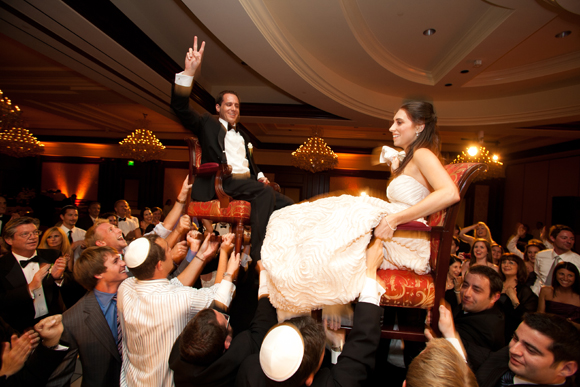
Mi Belle Photography