Category Archives: From the Expert

Ketubah As Fine Art: Part II

Today is Part II of a 2-part series by Ketuv, the website behind fine art ketubahs. Yesterday, the ladies of Ketuv discussed the importance of personalizing ketubah art to fit a couple’s style, history, and home. Today, Part II is all about how to commission an artist to create your perfect memento of your marriage.

Whether you go with a Ketuv artist or not, here are some tips on choosing an artist and finding a style.

There is no special formula to finding the right artist. Look around. You don’t have to know about art to have an experience with it. When you like something, listen to yourself. Try to notice what about the work you like. Is it the color? The composition? The content? The medium (that is, what the artwork is actually made out of)?

Collect images of the artwork you and your partner like, and look at all the images together. Is there a pattern emerging? Are you finding that you’re more attracted to abstract work, or something more realistic? Are you finding that you like collage work, or pen and ink? Detailed work, or something simpler and more elegant? Colorful or black and white? Once you find your artist, these images and what you like about them will be invaluable information.

Remember, when you are considering commissioning a specific artist, you should imagine that your ketubah, while made especially with your ideas in mind, will look stylistically somewhat like the other work in the artist’s portfolio. That is, if you ask an abstract artist to draw a realistic portrait of you and your partner, it probably isn’t going to work out. When you like an artist, go with their strengths and you will get the best results.

Text
This can sometimes be the trickiest part about commissioning an artist to make your ketubah. At Ketuv, we feel that “ketubah artists” might not always fit the bill for the kind of artwork you’d like to hang in your home, which is why we created Ketuv in the first place. In our custom process, we take care of the text, and the artist takes care of the artwork.

If you’re going with an artist friend, or any artist that can’t provide the ketubah text, several ketubah companies, including Ketuv, offer text-only ketubot. You should also be aware that while many ketubah companies copyright their texts, Ketuv’s texts are open source and available for use, whether you work with us or not.
Communicate!
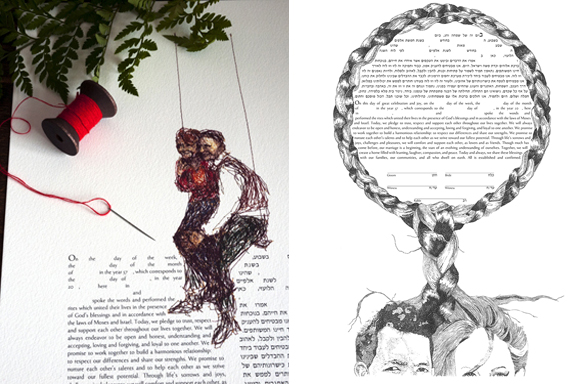
Let your artist in on the details of the conversation you had with your partner, and share your little folder of inspiration images, taking him/her through your vision for your ketubah. In one case, a couple even sent me a crude version of what they wanted, which they sketched out themselves in crayon!
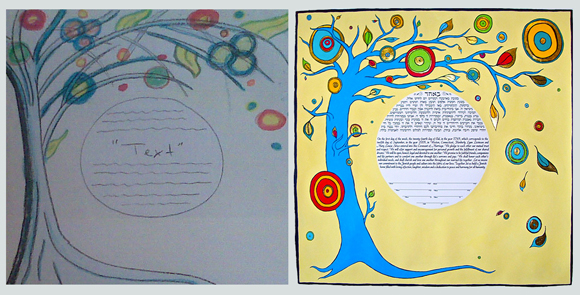
Once you and the artist feel secure that you have come to an understanding regarding the content and style of your ketubah, you’ll have to hammer out the nuts and bolts:
1. The price of the artwork
2. How much time the artist will have to complete the artwork
3. How many updates the artist will provide for you before you receive the finished product (i.e. Will s/he have to send sketches? Photos of the work in progress? How many?)

Even if the artist is a friend, it might be best to write this down somewhere, just so everyone is clear.

This may sound like a lot of work, but we believe that you and your partner can figure out the basics of what you’re interested in over the span of a dedicated afternoon. It might also be fun, an opportunity to literally “visualize” your relationship. Don’t forget that your artist will also bring something to the table. You don’t have to have everything figured out in order to start the conversation!

What’s more, you’ll be investing in an heirloom, a symbol of your love that will stay in your family for generations.
———————-

Your love is unique. We think your ketubah should reflect that.

With the plethora of generic printed ketubahs available on the Internet, couples with a discerning eye have a hard time finding something that speaks to them. We formed Ketuv to provide couples with a fine art option in ketubahs, and to create an opportunity for innovative artists, with dynamic careers outside of the commercial and Judaica spheres, to create fresh, quality ketubah art.

Founded by artists Arielle Angel and Maya Joseph-Goteiner, Ketuv is committed to creating new opportunities for artists in the marketplace, with the ultimate goal of allowing artists to pursue their craft sustainably and with integrity.

Ketuv is also committed to honoring the diversity of the Jewish people, as well as people influenced by the Jewish tradition. While providing quality wedding and anniversary ketubahs for Jewish couples of all denominations, we also pride ourselves on offering progressive options in wedding artwork for same-sex, interfaith, non-denominational and non-Jewish couples.
From the Expert: Ketubah As Fine Art: Part I

Today is Part I of a 2-part series by Ketuv, the website behind fine art ketubahs. The ladies of Ketuv discuss the importance of personalizing ketubah art to fit a couple’s style, history, and home. Not sure what to think about? No fear! Ketuv offers a lesson in ketubah art 101. Take it away, Ketuv!

You’re engaged. Mazel Tov! So begins the saga of wedding planning. You want to make sure it’s personal, that you and your partner are expressing yourselves in every little detail. And yet, when it’s time to choose a ketubah, you figure you’ll just find something with trees on it and call it a day, right?

Hold up. Long after the flowers wilt, and the bunted garlands come down, long after all the little details of your wedding day are preserved in photographs and sealed in an album on the shelf, your ketubah will still hang on your bedroom wall.

At Ketuv, our motto is that your love is unique, and your ketubah should reflect that. The ketubah is the first piece of artwork you and your partner will purchase together as a couple — the piece of artwork that makes you a couple, by Jewish law — and that’s a very special thing.

So why not go beyond the generic tree landscapes and watercolor Jerusalems and instead commision a real work of art by a contemporary artist?

For most people, the prospect of commissioning a work of art is an intimidating task. Here are a few tips for commissioning an artist to make your ketubah.

What’s Your Ketubah About?
Talk to your partner about what aspects of your relationship you would like your ketubah to highlight.

What do you feel is truly special about your relationship? For some couples, it might be the incredible way you balance one another. For others it might be a set of shared values. Be specific. You may or may not know how these ideas will translate into symbols or visual cues, but either way, don’t be afraid to write them down. These ideas are likely to become touchstones for the artist as they create your artwork.

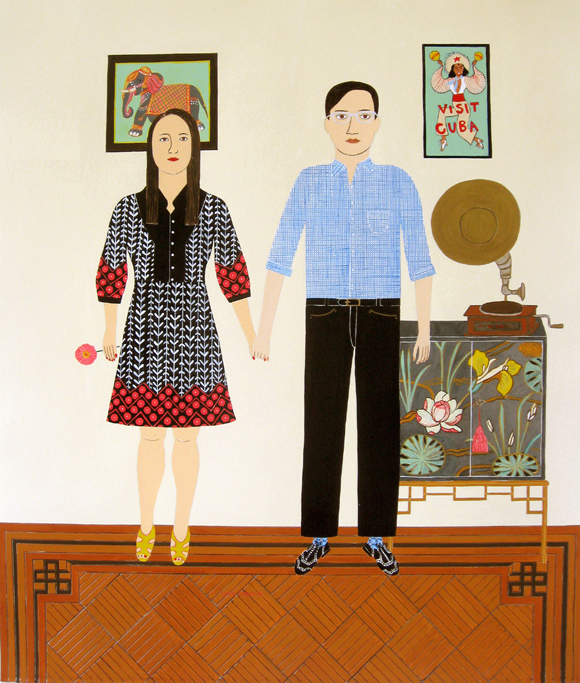
You may want to think about the stories that are important to you as a couple: how you met, the moment you “knew,” a trip you took together. Your ketubah can depict, say, the park bench where he proposed, or a map of all the New York City apartments you both lived in before you met one another. At Ketuv, we have artists who specialize in everything from maps to portraits to family trees.

Start Thinking About Color
This could be as basic as wanting the ketubah to echo your wedding colors, or the colors of your home, or it could be more symbolic. I once had a couple who wanted their ketubah in red and blue because she was fiery and he was more calm. They wanted to highlight that balance in their color choice. Don’t be afraid to get creative!

How should my ketubah look? How do I choose an artist? This is often the hardest thing for most couples who aren’t themselves artistically inclined. At Ketuv, we like to think we’ve made this easy, as we work with more than 20 artists from around the globe, with a range of different styles. We’ve included portfolios of the artists’ personal work, so couples can browse and get a sense of the artists’ capabilities.

How do you even commission an artist to create your ketubah art anyway? Swing by tomorrow for Part II of the series!

———————-

Your love is unique. We think your ketubah should reflect that.

With the plethora of generic printed ketubahs available on the Internet, couples with a discerning eye have a hard time finding something that speaks to them. We formed Ketuv to provide couples with a fine art option in ketubahs, and to create an opportunity for innovative artists, with dynamic careers outside of the commercial and Judaica spheres, to create fresh, quality ketubah art.

Founded by artists Arielle Angel and Maya Joseph-Goteiner, Ketuv is committed to creating new opportunities for artists in the marketplace, with the ultimate goal of allowing artists to pursue their craft sustainably and with integrity.

Ketuv is also committed to honoring the diversity of the Jewish people, as well as people influenced by the Jewish tradition. While providing quality wedding and anniversary ketubahs for Jewish couples of all denominations, we also pride ourselves on offering progressive options in wedding artwork for same-sex, interfaith, non-denominational and non-Jewish couples.

From The Expert: Create Your OWN Interfaith Wedding

Daniel Sroka is the artist and owner of Modern Ketubah. He creates modern fine art wedding ketubahs from his abstract photographs of flowers and leaves for interfaith, Jewish, and multi-cultural couples. The first ketubah he ever made was for his own wedding. He and his then-fiance, Cara, wanted to make sure they loved the artwork to proudly hang it in their home, and they also wanted to be sure that the text and symbolism was meaningful, especially as an interfaith couple. They decided that his fine art photography would be the ideal style to express their marriage, as many other ketubahs they saw while shopping were adorned with Jewish symbols, and did not match their taste or represent them equally. Since then, Daniel has successfully built a ketubah business that honors individual style and spirituality.

Interfaith weddings can be the most beautiful of wedding ceremonies. Of course, being in an interfaith marriage myself, I may be biased! But when interfaith weddings combine the traditions and practices of both the bride and groom, I find that they become something special, transcending rote ceremony and becoming a uniquely personal celebration.

The way an interfaith ceremony gets created is the key to its beauty. Couples who are from the same religion can pretty much take their ceremony for granted. They can visit their priest or rabbi, get the template, make a few tweets, and know they’ll have a 100% legit ceremony. Interfaith couples, on the other hand, don’t have this luxury. They have to creatively blend together the different parts of their traditions to craft a working ceremony.

The challenge of creating a ceremony often makes interfaith couples nervous and full of questions. How do you do it? How do you make it feel “real” enough? Will any of the relatives feel left out? But even though these questions can be nerve-wracking, they are the foundation of what makes an interfaith ceremony so special. Because interfaith couples can’t just take an off-the-shelf ceremony and call it a day, they need to think through every aspect of their wedding, considering every detail. This, I believe, results in a very meaningful and powerful ceremony.

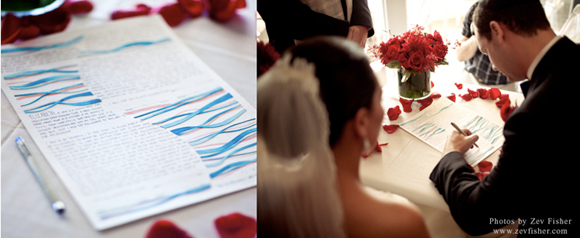
Artist Daniel Sroka and his bride with their interfaith ketubah he created.

In order to combine two different wedding ceremonies, interfaith couples have to review all of the practices within their religions’ ceremonies, and decide what to keep, what to change, and what to leave out. To do this, they first need to help each other learn, teaching each other about their religion’s traditions, symbols, and ideas about marriage. As my wife and I planned our own ceremony, we didn’t just learn about each other’s religion – we rediscovered our own, often surprising ourselves with what really mattered to us and what didn’t. We then went through each wedding tradition, discussed it, and decided if we wanted to include it in our ceremony, and how. Each part of our wedding was therefore a conscious choice. Each part of our wedding was born out of a deep discussion, and reflected a shared value.

The creation of the ceremony helped teach us how to discuss our differences, and find our similarities. Explaining the ceremony to our families helped us better understand our decisions and values. Even the experience of being a part of this blended, shared ceremony helped bring our families closer together. So while creating an interfaith wedding ceremony can take a lot of thought and planning, I believe it is worth it because your wedding becomes a celebration that truly represents who you are.

Left: The Srokas' ketubah and unity candle. Right: One of Sroka's ketubahs called African Lily

Dressing the Mother of the Bride or Groom

*****************

TODAY IS THE LAST DAY TO ENTER THE KETUBAH GIVEAWAY! You or your loved one can enter the ketubah giveaway on The Wedding Yentas with Ketubah Studio by MP Artworks! Photo submissions are being accepted right now through February 16th at 11:59 p.m. PST Email photos to alison@theweddingyentas.com now so you don’t miss your chance to save big on this Jewish ceremony ritual! Details here!

*****************

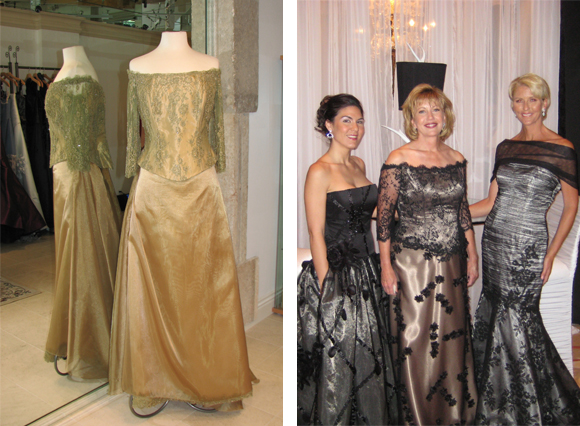
Andrea’s Couture, the sister salon to Andrea’s Fashions, serving women of Beverly Hills for 37 years, has opened in Corona del Mar offering the luxury of exquisite customized gowns in the convenience of Orange County. Women are treated to exceptional customer service by this family team as they choose from close to 400 dress options (various skirt patterns, necklines, lengths, etc.) to customize their style and over 250 colors before being custom fit using 22 measurements. This allows for endless combinations, creating a one-of-a-kind gown guaranteed to fit impeccably. The salon also offers select accessories.

One of the most exciting days for a mother is the day her child gets engaged. Everyone is very excited for the upcoming nuptials and the planning begins. Then months of planning go by and everything gets wrapped up. However, one of the last things on the list is usually the mother’s attire. I am not really sure why it happens like this, but it always seems to be the case. The majority of mothers do not think of their own gown until the last moments and expect to find the perfect look for an event that takes a year to plan by just taking a quick trip to the local mall. What a mother doesn’t know is that it takes just as much effort to find her gown as it did to find the bride’s gown.

It is important to keep in mind that half of your guests have never met you. It is my job to make sure it is obvious to everyone at the wedding that your role is the mother of the bride/groom and to make you feel your best on the day of the wedding. The photographs will last forever and so should your amazing memories of that day.

It is evident that there is no easy answer to the dilemmas mothers face in their gown search. Sleeve or no sleeve? Short or long? To match or not to match the bridal party?

There truly is no short answer. However, Andrea’s Couture boasts over 37 years of experience helping ladies make the right choice.

Here is my professional take on these questions:

Sleeve or No sleeve?
The mother of today is more youthful than ever before. After all 50 is the new 40, right? However, very few ladies accept that there is a normal change in the texture of their skin that occurs over time. Therefore, there is a bit of an epidemic of “bye-bye” arm obsession. (Ladies, the only one looking at your “bye-bye” arms is you). Hot flashes are bad enough, so why add fabric to compound the issue? It is not necessary to cover your entire shoulder to achieve a demure and sophisticated look. Wearing an on-the-shoulder sleeve instantly adds at least 10 years to your gorgeous face. I understand that you need to feel comfortable in your attire, but, unfortunately, long gone are the days of column dresses with little matching jackets. That being said, there is something regal about a portrait neckline or a soft Juliet sleeve to finish off a mother’s look. There are also stunning boleros which achieve an amazing line for a woman. Lastly, for Jewish weddings, a shawl tied appropriately can make a rabbi happy. Or for a very religious woman, I can create a dress that has a seamless transition to a narrow sleeve line with no obvious indication that you have added sleeves to a strapless dress.

I offer all these options in my store, Andrea’s Couture, simply because there are no two women with the same exact needs. A little more or a little less coverage is something that can be easily achieved with my professional experience on your side. It is my #1 goal that every single mother feels her most beautiful while celebrating at the wedding and I stop at nothing to achieve this.

Long or Short?
I firmly believe that this is indicated by each individual event. Today’s bride is savvy and is adding personal touches to her event. If the bridesmaids are wearing short, then the mothers should wear short, too. If the bridesmaids are wearing long, the mothers should also wear long. Tea length (mid-calf) is not a happy middle-ground for a mother. She should wear short (at knee or just below knee) or long.

Now, this is not to say that a long dress has to have a dramatic train. It can simply touch the floor. I personally love to create a long dress for the affair because after the wedding, I can shorten it to cocktail length. This always helps in amortizing the purchase and allowing for future wear. In our boutique, we have many designs that we have created long and short to illustrate how amazing each can look.

To Match or Not to Match?
Many women unfortunately struggle with the color selection of the gown. A simple rule of thumb is that mothers should never match the wedding party or the other mother of the bride or groom, but rather they should complement the wedding party. A mother should never look like a glorified bridesmaid, and a mother should never blend in with her guests. Furthermore, the mother of the bride and mother of the groom should not wear the same color either.

There are some simple color choices. For example, if it’s a black and white wedding then the choice has been made for you. The other side of the coin is that there are some color choices that are more challenging. For example, I recently created a breathtaking mother-of-the-bride gown that was ballet pink with a combination of silver and pink beading for a charcoal and pale yellow wedding.

Here are some other scenarios: If the party is wearing Wisteria or lavender, the mothers can wear burgundy, royal purple, silver, charcoal gray, or navy. Or if the party is wearing nude/champagne, mothers can choose sage green, gold, dark reds, rusts, bronze, or chocolate.

In the past when searching for a gown, women have been forced to pick between a few mainstream colors such as navy, chocolate, green or champagne. With over 150 colors in each gown, Andrea’s Couture never limits your options.

From the Expert: Getting Married in Israel

It’s so exciting to have a special guest today on The Wedding Yentas who will be teaching us all about getting married in Israel! Tracey Goldstein is the Editor and Creator of Hatunot: The English Speaker’s Guide to Planning a Wedding in Israel. Tracey moved to Tel Aviv in 2010 and previously founded and managed NYC event planning firm, Polka Dot Events. Hatunot is the Israeli version of The Wedding Yentas, and as an American living in Israel, she knows exactly what brides in the U.S. love about weddings and what they should know about weddings in Israel. Funny, intelligent, and personable are perfect adjectives that describe Tracey, and it’s an honor to be BFF (Blog Friends Forever) with Hatunot!
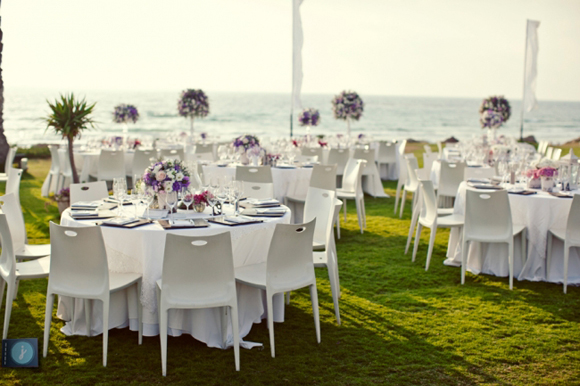
When most Americans think about Israel, a collection of thoughts comes to mind; desert, war and camels, cute Israeli soldiers, delicious hummus, beaches, and maybe even a fun Birthright trip. But what most don’t know is that Israel could be on the map as the world capital of weddings! Before you go and book your destination wedding in the Caribbean, check out some of the top reasons I am so crazy about the wedding industry in Israel, and why I think YOU should celebrate your hatuna (“wedding” in Hebrew) here, too!!

The Ultimate Venue Selection
Sprawled across the country are hundreds of indoor-outdoor venues of equal quality to the venues American brides pay top dollar for as they cross their fingers for decent weather. Israel offers garden spaces, beachside hotels, modern lofts, and rustic farms all in a country the size of New Jersey. And since Israeli guest lists are often so large (the average Israeli wedding has 500 guests, while the average American wedding has 100), venues and vendors are much more accommodating for large groups. Why pay the typical $250+ per plate demanded by Manhattan catering halls when a Tel Aviv venue that is often larger, newer, and serves better food will charge only 250 shekels?! Kosher catering is almost never an issue, nor is the weather. Plan your event anytime between May and October and you can sleep easy knowing no last minute tents need to be ordered.

Venue: Cochav HaYam in Caesarea & Photo by John Edgar

An Incredible Trip for Your Guests
While destination weddings in the Caribbean, Mexico, and Hawaii are the perfect excuse for a vacation for your family and friends, inviting them to your wedding in Israel is giving your loved ones the opportunity to take the trip of a lifetime. Israel has the beaches, the restaurants, and the fun, but it also has the ancient history and spiritual significance that no other place in the world can truly match. And while the distance will certainly come with “destination” wedding expenses for family and friends abroad, the Israeli tourism industry encompasses numerous tour organizations than can assist with group flight and hotel rates, transportation logistics, and countrywide tours so guests will surely feel they’ve spent their money’s worth.

Talented and Enthusiastic Vendors
The one thing I have definitely learned from running my wedding blog is that Israel is full of talented, enthusiastic vendors that are fluent in English and dying to work with couples from abroad. Photographers, videographers, DJs — you name it — there are tons of vendors here that really understand American standards and taste, and can produce high quality services.

So Many Bridal Gowns!
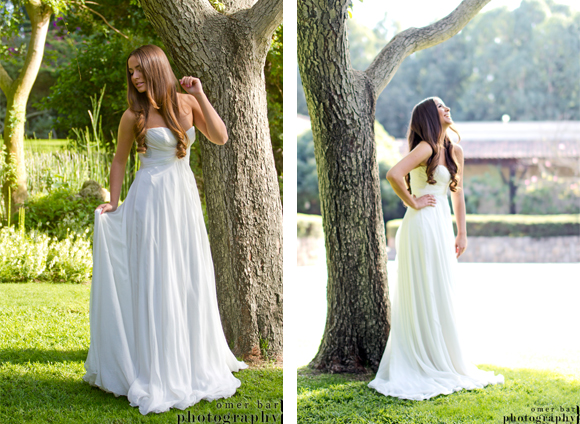
Taking a walk down Dizengoff or Ben Yehuda Street in Tel Aviv? You’d have to be blindfolded not to notice the dozens of bridal gown shops, less than feet apart. Yes, I’ll admit there are a few designers who specialize in the see-through-bustier-cupcake-gown that can give any modern bride nightmares, but Israel has an immense selection of sophisticated, modern, romantic, and non-poufy dress boutiques for brides all over the city.

Omer Bar Photography & Dress by Limor Rosen

A Land of Milk, Honey, and Informalities
With so much diversity and such a central geographical location, Israel is a mix of European, American, and Middle Eastern culture. But what I think is so unique about this country is that it is a place to drop formalities. A wedding in Israel does not need tuxedos and bow ties, you do not need to have 12 bridesmaids, and the series of father-daugther, mother-son, grandma-uncle, my half-brother from my dad’s third marriage dances. It is about good food, dancing, and celebrating. Therefore Israel is the perfect place to wed if you are looking for a fun and comfortable environment.

*****************

Don’t forget to take a minute to enter you or your loved one into the ketubah giveaway on The Wedding Yentas with Ketubah Studio by MP Artworks! Photo submissions are being accepted right now through February 16th! Details here!