Category Archives: Jewish Traditions

Dating a Wedding Date

Every Yenta (not just us) will ask you, “So? When’s the date?” You take another bite of brisket and swallow hard. You’re not sure how to answer. You haven’t picked a date yet.

Every member of your mother’s temple sisterhood is hounding you for the date and you haven’t figured it out, but you’re feeling pressured, and you still need to do more research because once the date is locked in, it’s a done deal, so you reach and reach for an answer to give her but she’s still staring at you, expecting an answer so even though you’re picturing yourself in a strapless, flirty tea-length wedding dress standing under a chuppah adorned with pink and cream peonies, you’re not sure when those flowers are in season, so it really depends on the date you get married, and oh gosh, she’s still waiting and she has a chunk of mascara dangling from her left eyelash and now that’s all you can think about so you just blurt out: “We don’t know yet.”

There it is. That look of disapproval. HOW CAN YOU NOT KNOW YET?

There are tons of reasons!

Early on in the site’s young life, we provided you a list of holiday weekends for Sunday night weddings over the next 3 years. But what if you have questions that span outside the no-weddings-on-Shabbat rule? What if there are other holidays or mourning periods that come up while you’re trying to plan your wedding and set a date? Jewish marriages are not to be performed during points throughout a year, and we are here to help explain these calendar crossovers.

RELIGIOUS RESTRICTIONS
There are no weddings on:
The Sabbath (Friday to Saturday 30 minutes after sundown).

The major holidays; you know, the usuals: Rosh Hashanah, Yom Kippur, Passover, Shavuot, and Sukkot (sundown to sundown). Basically, every holiday you probably celebrated or heavily discussed at Hebrew school (though you may not remember because you were distracted with the happy possibility of being invited to Seth Silverstein’s Bar Mitzvah where you may be able to play Pepsi-7up and sit on his knee).

Orthodox and conservative congregations also don’t permit weddings during The “Three Weeks” (which are the 17th of Tammuz to the 9th of Av, which usually fall in July and August) and the Sefirah period (these are the 7 weeks between Passover and Shavuot, except for the holiday of Lag b’Omer, which is usually in April and May).
These times are actually considered national mourning periods due to historical tragedies such as the destruction of the Temple and a plague that forced its way through the greatest and noblest scholars of the time.

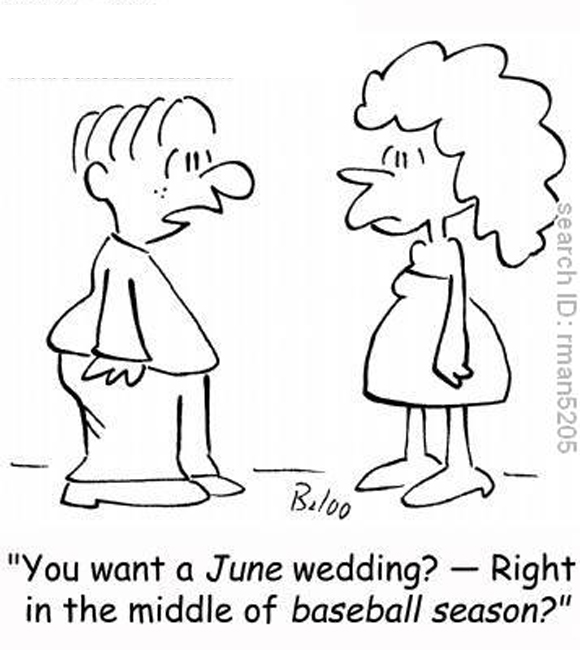
And, this brings us to the reason why June is the most popular time of year for a not-too-hot, not-too-cold wedding.

PERSONAL MOURNING PERIODS
If you and your husband-to-be are in mourning, then you can’t secure a wedding date during the 30 days of mourning that are typically reserved for a brother or sister. Additionally, you can’t plan a wedding date during the 11 months observed for a mother or father. Reform practitioners usually go with the 30 day rule for any kind of mourning period. If you’re unsure, the usual Wedding Yentas disclaimer applies: Ask your rabbi.

However, if the date has already been set, you may not postpone a wedding even if there is a death (pooh pooh) in the family. Rabbis say that a marriage is the highest of mitzvot and even mourning is not allowed to interfere with such a wonderful occasion. The wedding should go on as scheduled, but personal decisions may be made about scaling down the festive atmosphere. Again, can I get a giant bubbie-style “pooh pooh” and 3 spits please? Thank you.

PERSONAL PONDERINGS
Here’s the part where you check your own calendar to make sure you don’t make a big uh-oh on top of the Jewish practices. What kinds of flowers do you want? If you want harvest symbols or chrysanthemums, you might like to be a Fall bride. Tulips and dahlias make you a perfect picture of a Spring bride. Do you have a special date like your dating anniversary or honoring a relative’s wedding date? Do you need to make sure other occasions aren’t close to your wedding date because of your sister’s graduation or your brother-in-law’s leave from the military? Is there another family wedding that might conflict with your ideal date?

Remember this bit of important wedding advice: You won’t be able to please everybody. Follow the Jewish laws as you see fit and steer clear of personal conflicts. As long as your most favorite people are there to witness you and your groom get married, your special day will still be the happiest.
Tick Tock to the Simcha: Part II

On Monday, we brought you Part I of the time line we suggest you follow while planning your wedding. Today, we continue where we left off and hope that the complete time line brings you peace of mind and excitement to the wedding planning process!

2 Months Before

  • It’s time to order your yarmulkes. To personalize them, complete the order with your names and wedding date so guests have a memento of your day. This can be your Hebrew names and Hebrew date or your daily names and modern date. Consider the fabrics you’d like (shiny, suede, etc.) and color (black, white, blue, etc.) Something to think about when it comes to yarmulkes: in photos from the back of the ceremony, white or beige yarmulkes can make it appear as though all your male guests are bald. If you’re not married to a specific color, perhaps you might order blue, brown, or black yarmulkes since they are dark and will match most men’s hair.
  • If you chose to book an aurfruf, start learning the Hebrew blessings. This could be anything from simple blessings before and after the Torah reading or more elaborate prayers. Check with your temple and rabbi.
  • Order programs and benchers (prayer booklets) for your ceremony if you are including them for your guests. We believe that it is helpful to have programs available during your ceremony so that non-Jewish guests have the opportunity to understand the beautiful rituals and symbols of the Jewish wedding. You can order these premade, or you can design your own. We recommend designing and printing your own because it can be a fun project for you and your fiance to complete together!

jewish-wedding-program

6 Weeks Before

  • If you are choosing to visit a mikvah (ritual bath), you should make arrangements for this event now. Also, you may plan a small party to follow the mikvah. This is a very traditional and beautiful Jewish event for a bride. Depending on your movement of Judaism, you may or may not plan to do this.
  • Finalize any last minute vendors. Perhaps you decided after all to hire a videographer or to rent chair covers. This is probably the last chance you’ll have before you’re out of luck. Make sure to assess your vendor list and check off finished business.
  • Make sure you’ve had a food tasting by now with your venue or caterer. This fun wedding-planning moment will give you an idea of what to expect on your wedding day. Giving your venue or caterer enough time to plan the menu for your day is key.
  • Practice makes…pretty! Now is the time to meet with your hair stylist and make up artist – either together or separately – to have a trial of your wedding day look. Your hair should be grown out to the approximate wedding-day length by now and you should have an idea of what you want your makeup to look like. Bring magazine photos, hair accessories, and a clean face.

3 to 4 Weeks Before

  • Meet with your officiant one last time to go over the ceremony.
  • Make sure that those who are participating in the ceremony understand what is involved (this is especially true if you are not having a rehearsal).

1 to 2 Weeks Before

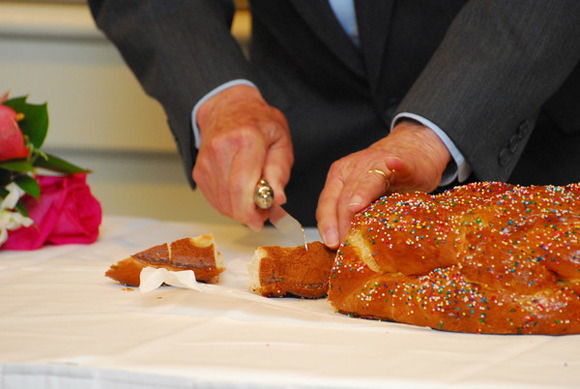
  • Remind your caterer to order ritual foods like the challah, wine, and any other needed items. If you’re not ordering from your caterer, make sure to secure these items on your own or through other vendors. Challahs need to be special ordered for a party the size of an average wedding and you want to make sure you’ve selected your Kosher wine.
  • Provide your wedding party with a breakdown of the wedding day and a time line of the wedding weekend so that everyone is on the same page about the times and locations of the festivities.

1 Day Before

  • Hand over the important and valuable items to someone reliable who will also be near you and your partner the day of the wedding. This person, usually the Best Man, will have the rings, papers with vows, and any other items necessary for the ceremony.
  • Depending on your venue’s contract, you may be able to “move in” the day before your wedding. On this day, bring all items you’ll need for your ceremony (ketubah, easel, pens, glass, wine, etc.) and for your reception (candles, table numbers, favors, escort cards, etc). Obviously you and your venue must be in agreement about this, but we suggest you pack ceremony things and reception things into boxes for ultimate organization and an easy “move in” day.

There you have it: A basic time line for a Jewish wedding. Now, there are zillions of other things you need to check off your list as the time tick-tocks away, and we’ll cover more specific items in the future. Use this as a reference to make sure you’re on the right track. Specific vendors and couples require slightly different variations of this time line, but we hope to get your mind jogging and headed toward the right direction: happy, wedded bliss!

Tick Tock to the Simcha: Part I

A lovely whirlwind of excitement and love follows a proposal. Once the ring starts sparkling on the finger, the bride begins to execute all of her wedding daydreams and turn them into realities. It all sounds fun and girltastic, but when it comes down to the nitty gritty, the panic starts to set in.

“When do I choose a rabbi?”
“What bridesmaids dresses can I get that fit the girls and the temple’s requirements?”
“When does the timer go off on my wedding gown shopping?”

These are all rational and normal questions and a little timeline goes a long way. Here’s a guide that should help you stay on target and keep your anxiety at bay. Feel free to plug in trips to your therapist on an as-needed basis.

12+ Months Before

  • Start imagining your ceremony. Do you want it long and traditional? Short and sweet? Are you planning to include every single ritual or are you leaning toward an abridged version?
  • Choose some preferred wedding dates. There are times of the year that Jewish weddings are off limits. Check out this previous Yentas post for those details.
  • Choose your location. Do you want the ceremony in synagogue? If you belong to one already, that should be easy. Or, you’ll have to search for local synagogues. You can also have your chuppah in a secular location. Think of a favorite place outdoors or get in touch with a paradise-like country club or hotel.
  • Start your search for vendors (photographer, caterer, and reception entertainment as a start) and meet with them to discuss their work. Matching your personalities with theirs is important with musicians and photographers because you spend your whole day with them. This is also when you decide if you want a kosher or kosher-style meal. When you meet with a band or DJ, make sure they can play “Hava Nagila” and are familiar with Jewish traditions.
  • Start researching and narrowing down ideas for an officiant who suits you and your partner. Whether it’s a rabbi, a cantor, a rabbi and a [insert other religion’s clergy here], a justice of the peace, or a friend, you need to know who will be facing you under the chuppah.

9 to 11 Months Before

  • By now you should have an officiant, so meet with him or her to discuss the ceremony requirements. Discuss the different traditions of Jewish weddings and decide which ones you’d like to include on your wedding day.
  • Confirm with your officiant or synagogue if there are requirements for clothing for men and women. Make sure to ask if there is a rule about covering one’s shoulders or if the groom must wear a kittel (ceremonial robe).
  • Coordinate with your temple if you plan to have an aufruf, the honor of blessing and being blessed before the Torah reading on the Shabbat leading up to your wedding.

closter-nj-real-jewish-wedding

6 to 8 Months Before

  • Decide what type of ketubah you and your partner want. Start your search for a ketubah artist if you’d like one custom made for you. Select your text or ask your officiant to assist you in writing your own. For more on the ketubah-shopping process, see our guest-blog feature by artist Rachel Deitsch.

find-a-ketubah---ketubah-studio

3 to 4 Months Before

  • Get in touch with people who you’d love to be honored at your wedding with certain readings or songs. This is also when you should decide who will sign the ketubah. If your chuppah is hand-held, who will hold the chuppah? Is there a family member who you’d like to make the blessing over the challah or wine?
  • Make more purchases! This time, shop for and buy your wedding bands. Remember, according to Jewish law, you must use a simple band without separations or stones. For more details, see the Yentas post on ring requirements. Also remember that this requirement is for the ceremony, and you may still purchase and wear a more ornamental ring after the wedding if you wish.

la-diamond-factory

  • Think about what type of chuppah you want. Does your synagogue offer them if you get married on-site? Do you need to arrange this with your florist? Is there a chuppah rental company near you? Do you want a simple tallit to be your canopy or do you want something more elaborate?
  • Book a rehearsal dinner site and make note of the final invited guest list. Also, secure your wedding rehearsal date and time with your venue and VIPs. Also, FYI, most rabbis will not participate in a ceremony rehearsal because they believe that the chuppah ceremony is sacred and should only be experienced once, therefore, they urge couples to save the experience for the wedding date. Not every rabbi or officiant believe this, but this is something to confirm. However, you can still have a celebratory dinner with friends and family the night or two before the big day as a welcome and get-ready-to-party party!

…To be continued…

Check back on Wednesday for the rest of the timeline so you’re on track to your big day!

Love It A Latke!

It’s Chanukah! This means presents, fun with family, and lighting pretty candles for eight nights.

This also means food. Food, glorious food. Chanukah is my favorite holiday for food simply because of the latkes. I get sick of matzo after so many days and I’ve never had an appetite for gefilte fish. I can do without coconut macaroons and jelly donuts just aren’t my thing. But latkes. Oh latkes, and your oily, starchy goodness. Come to me and cuddle up on my plate.

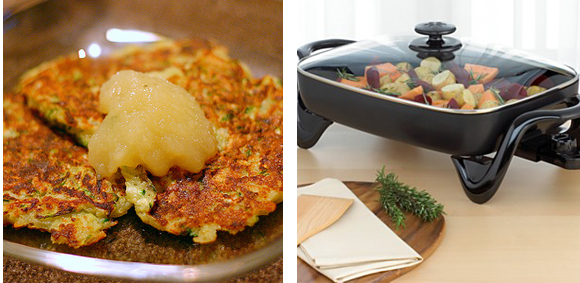
If there’s one thing I thank Judah Maccabee for, it’s for my latkes. I also thank him for giving me a reason to have an electric skillet. Brides, grooms, people in the market for new kitchenware: Register for an electric skillet! You will use this every year at Chanukah to make latkes and you can get them at almost any store with which you register.

Macy’s, Bed, Bath and Beyond, Williams-Sonoma, and Bloomingdale’s all have great options for electric skillets that will keep you sane in the kitchen during Chanukah.

Latke photo (left) courtesy of: The Smitten Kitchen

So get your guns, bring your partner-in-registering-crime, and shoot this baby with the scanner so you can make sure you receive this appliance that’s almost as miraculous as the holiday on which you’ll use it!

While you’re registering with Chanukah on the brain, make sure to scan a food processor for shredding your potatoes, some mixing bowls for your potato and onion mixture, and durable spatulas to flip your pancakes.

When I dashed through the store with my handy-dandy registry lethal weapon, I had the holidays in mind. I knew that one day, I’d be a Jewish domestic diva (okay, still waiting for the diva part to happen), so I went through the calendar and thought about what I’d need to accommodate each big day of the Jewish year. Let’s face it: our people eat. As the saying goes, they tried to kill us, we survived, let’s eat. So a lot of my registry had our holidays in mind. Shout out to my mother-in-law who knew we’d need an electric skillet to emulate her fabulous potato latkes.

And in case you need a refresher course on how to make latkes, or, if you just want to see an A.DOR.A.BLE bubbe teach you how to make them, tune in below for a little latke love!

I think my favorite part is the end: “I’m packing this up for you.” Love it.

Two Of A Different Kind: Planning an Interfaith Wedding

We are honored to have a rock star cantor guest-blogging for The Wedding Yentas today! Cantor Debbi Ballard of My Personal Cantor is here to unmix any mix-ups you may feel if you’re planning a mixed wedding! If the man of your dreams isn’t Jewish or if you’re still getting the hang of the Big J, you might be feeling some stress or confusion. Relax and read on as Cantor Debbi provides you some nuggets of wisdom from her many years of officiating interfaith weddings!

Congratulations! The day you’ve dreamed of forever has finally arrived, and you are newly engaged! What joy! It is so much fun to choose the venue, flowers, music, and colors for that special day. There are so many choices to make, and so many ways to make your wedding day a reflection of your individual personalities, and you are having fun doing it! Well, at least it was fun, until one of your parents asked you the “Question” –
Mother # 1: “Of course, you will respect your heritage and have a Rabbi officiate at your wedding…right?”
Mother #2: “Fabulous! I’ll call the Pastor! The wedding will be so beautiful in the church you grew up in!”
(notice that inevitably – there is just the appropriate amount of guilt inserted in Mother #1’s request….)

OMG! What to do? How are you going to pull this one off? Colors? Easy. Music? You knew exactly what band/DJ you wanted from the minute he proposed! Venue? A few tastings, and extra calories to work off, and you’ve got a hot spot. But, how on earth are you going to please your mothers, and make this ceremony a fair representation of both of you?

I cannot tell you how many desperate emails I receive every day from brides and grooms who are ready to pull the plug on the whole wedding planning idea because they have found out that the problems they encounter seem insurmountable, and they have no idea where to turn.

I hear from people all the time: “Well, we took out all the Jewish and all the Christian, and came up with a beautiful ceremony.” Great, but that pretty much gives you a civil ceremony. Certainly you want something a little more special (or faith-full) than that?

You both came from different faiths, and those rituals and traditions that you always dreamed of having are important to you, perhaps not in your every day secular lives, but your grandparents and parents are counting on you “honoring” your faiths, and you owe it to them — and to yourselves — to do just that.

image-courtesy-of-borrowed-blue-photography

RELAX! I know your hearts are beating fast and your pulse is racing just at the thought of the conflict this process is going to entail. But, with a little bit of guidance, and a few very simple rules to follow, you can do it!

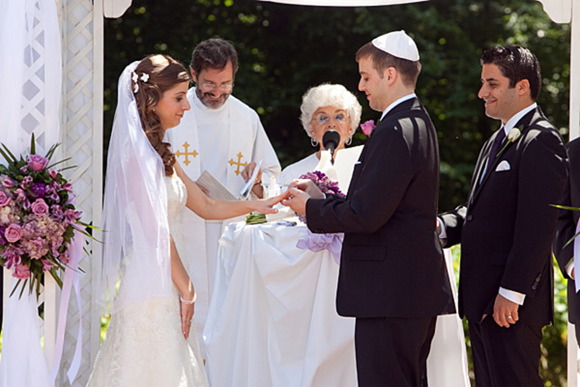
Let’s get one thing straight: in the world of interfaith weddings, there are no rules! You need an officiant who will embrace you — a couple from two different faiths, and all that goes along with that. Sure there are Rabbis/Cantors who will tolerate you and tell you what has to happen, but then again, there are others who believe, at their very core (yes, this is me!) that love is amazing, and because it’s no longer a given that love happens within the boundaries of our faiths, we should celebrate the love and unity of the couple, focusing on what unites us rather than what divides us. Therefore, rules, traditions, rituals, etc. are there for us to use as guides, not hard core must-dos. Many rituals and traditions of a Jewish wedding have specific biblical origin, but they also carry modern-day symbolism that you can incorporate as far less religious and way more meaningful today.

Planning what that ceremony looks like most definitely begins with that awesome officiant who is creative and open minded, but also eloquent and able to handle sensitive issues and questions from parents and inquiring relatives. (So many times, it’s an aunt or uncle who proves to be the most “interested” in how things are going to look).

Each ritual/tradition brings with it a biblical/religious meaning, but also a modern-day, spiritual interpretation. You can include biblical traditions such as the Seven Blessings, the chuppah, and the breaking of the glass by incorporating the meanings and relevance to our lives today, rather than the strong religious connotations it might have originally carried.

Often, my couples incorporate the Seven Blessings, but have their friends and family read seven custom-written blessings, rather than the biblical translation. Or, when I am co-officiating a wedding, I often sing the Birkat Kohanim (Priestly Blessing), while my co-officiant leads the Lord’s Prayer. (Actually, the Lord’s Prayer is rooted in our Jewish prayer, The Kaddish, so they’re actually related!)

The important thing to remember about planning your interfaith wedding is that you want and need this day to be about your union, so you need to focus on the things that unite you, rather than divide you. From there, everything is possible to negotiate and navigate.

Of course, some more serious issues arise, such as the style of the processional, parents standing at the chuppah, whether a yarmulke (kippah, or head covering) is worn, and many other issues, but again, when you are focusing on what you want to create for your wedding, and making choices based on that desire, everything will work out.

But when it doesn’t, when things begin to break down, and you are feeling overwhelmed, remember that it is a day, not a lifetime. Have conversations about what you want your life to look like, and remember you are each others’ best friends. Look to your officiant for guidance, or enlist the help of resources like www.Interfaithfamily.com. I highly recommend Rabbi Devon Lerner’s book, Celebrating Interfaith Marriages, or just seek out advice from other brides on the web. You are not the first, nor will you be the last, but you absolutely can plan a beautiful, inclusive, and original interfaith wedding! Enjoy the process, and most of all, have fun!

After more than 20 years in corporate management, Cantor Debbi Ballard decided to pursue the passions of her heart, and combine her love for music, faith, and people into the most rewarding career of her life! Today, as a Cantor specializing in performing Jewish and Interfaith weddings, you might find her officiating a ceremony in Florida, The Caribbean, Mexico, or even on top of a mountain! Debbi is known throughout the world for creating personalized, spiritual ceremonies, filled with warmth and passion. Her deep sensitivity for people, eloquence, and dynamic personality, help her create wedding ceremonies her clients and guests remember for a lifetime! Visit Cantor Ballard online at www.mypersonalcantor.com.