Category Archives: Jewish Traditions

All Inclusive Wedding Day

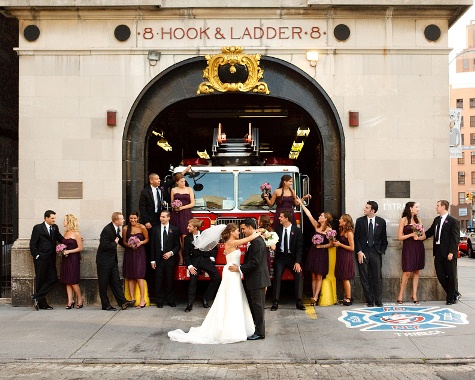
This is a very good problem: You have childhood pals you’ve known since nursery school and you have sorority sisters from your time away at college. You have a cousin who’s like your clone and you have high school friends who you are still in close touch with. And then you and your partner both have siblings and they’re also in your inner circle. Poor you! You are loved by too many people and you can’t possibly have them all in your bridal party. Well, you could, but not only would your processional be longer than your ceremony, but your photographer might kill you. (Am I right, photographers?)

First, pick your bridal party. This may be difficult because you really have to narrow down your fan club, but check out this recent post that may help you feel better about it. After you’ve secured a reasonable amount of bridesmaids and groomsmen, then think about who else you’d like to honor with VIP status.

Is one of your favorite people a good singer, speechmaker, or musician? Ask them to “perform” at some point during your wedding weekend. You may ask someone close to you to give a speech or sing a song at your rehearsal dinner. There might be a point in the ceremony that someone could recite your favorite poem, or sing as you walk down the aisle. Someone special could also do the motzi over the challah or the Birkat HaMazon, the blessing after meals, thanking God for the food and His support in general. You’ll want to limit the amount of speeches during your reception (too many makes it a snoozer!), but think of other special times during your wedding event that can include putting your favorite people in the spotlight.

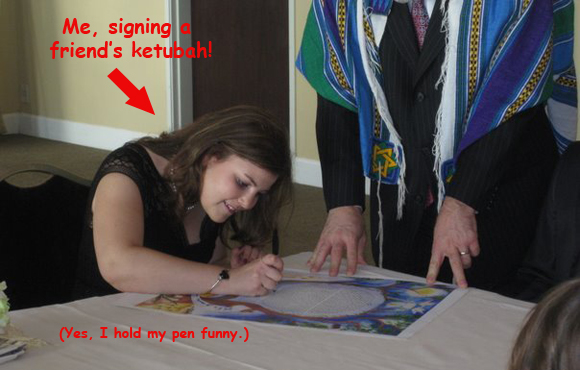
Pick your ketubah signers! Typically, there are two of them, and this is a huge honor. Their signatures will be on your beautiful ketubah forever and if you choose to hang it in your home, you will be reminded of these people whenever you look at it. They are invited into the room where you sign the ketubah and this is usually a private event before the chuppah ceremony. I’ve personally signed the ketubah twice for my two best friends and it was a joy to be part of the official Jewish marriage portion of the day. Remember, the ketubah signers must be Jewish and not be blood relatives. Your ketubah signers should be able to tell your rabbi or cantor their Hebrew names, and can receive help on the wedding day if the ketubah calls for writing their name in Hebrew.
Choose your marriage license witnesses. These can be the same people as your ketubah signers or you can extend the honors to two separate people. These people don’t have to be Jewish and are there to sign the marriage license that you must have with you on the day of your wedding. Your officiant should mail it in for you, and after the wedding, you should receive the certificate of marriage, but you’ll need two witnesses. This is also a really big deal for the signers since the document makes the marriage official in “the system.”

For fellas who are close to the bride or groom, there is a job for them that makes them some of the most popular men at the party. Designate some hefty dudes to hold you two up in the chair during the Hora. This doesn’t always have to be an invitation-only ritual, but it might be a fun way to honor some men who didn’t make it into the wedding party. Plus, they’ll be in all the fun photos of the chair lifts!

There are always the more job-like honors: ceremony ushers, guestbook facilitators, and escort cards host. These really are more like tasks, though, so think long and hard if it’s more of an honor or a chore for the people you ask to do this. Depending on the size of the wedding, and the style and locale, you may or may not want to ask people to do this. Sometimes it’s not necessary, but you know your wedding and your friends best, so make the decision based on the facts. These are just last-ditch ideas.

Think outside the box, too! Perhaps there are fun and unique details you’re choosing to include in your wedding day. Ask yourself how you might weave in your favorite people to honor them and then create an exciting way to ask them. Hopefully, this solves your terribly unfortunate problem of having so many wonderful people in your life!

Wedding Veils and All The Details

Let’s talk about veils. To wear one or not to wear one? If you choose to wear a veil, then which kind of veil should you were? There are, like, a zillion styles. So what should you go with? What’s the terminology? Does the veil have to match the dress?

There’s so much to think about for an accessory that’s pretty to look at and serves a cultural purpose. Read on for information… unveiled.

Camo is a No No
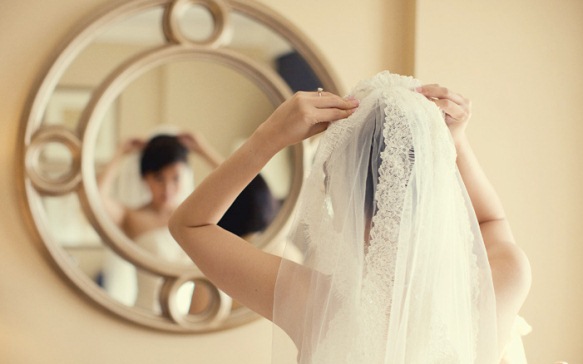
If you choose to wear a detailed wedding gown that sparkles with beading or has serious texture like lace, consider wearing a veil that doesn’t clash or hide those elements. What a shame it would be to select your dream dress and then cover it up with a veil that hides jewels or fancy buttons. An elbow-length veil will still serve its purpose but then also not upstage your dress.

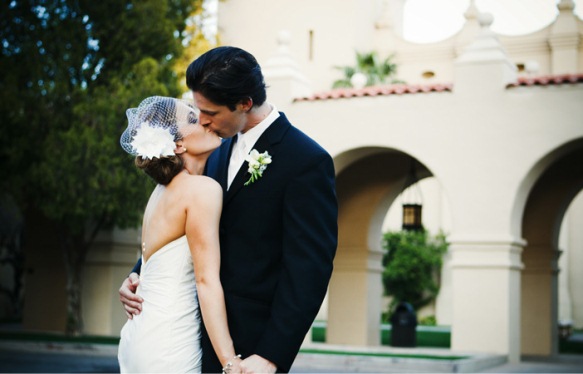
Caw! Caw! Wear a Birdcage
For serious drama or a vintage look, the birdcage veil is a classic. If you want a more traditional veil for your ceremony, you could always model a birdcage piece for photos or the reception. It’s a super-chic look that many brides love, but think they can’t pull off!! Just make sure your dress is in the same category of style. A very full and conservative gown might not mesh (haha, get it?) well with a birdcage veil, so go with a dress that’s sleek or sexy or vintage.

Image courtesy of Holladay Photo

Can’t We All Just Get Along?
Don’t let your dress fight with your veil. Instead, they should complement each other! If your dress has beading or pretty, sparkly doodads on it, then your veil should lean toward the plain side. If your dress provides simple beauty without jewels or lots of lacy additions, then your veil can have elaborate extras. But if you combine both, the veil and the dress will end up in a one-upping competition and you’ll lose the splendor altogether. This goes for your jewelry, too. The more detailed your veil is, the softer and simpler your jewelry must be. All three elements should definitely play well together, and not against each other. There is definitely such thing as too much of a good… bling.

Color Me Bride
Make sure to color coordinate! While you don’t want your dress and veil details to be too matchy-matchy, you definitely have to make sure your colors are! If you are wearing an ivory dress, it would be no bueno to wear a diamond white veil. Many bridal salons will offer you swatch samples to compare and be sure that both items match. There is no wrong color — it’s up to you to decide what works for your style and skin tone — but you definitely want to be sure that the color is consistent for both beauties.

Veil Types
You’d think that a drapey piece of mesh would be a no-brainer shopping experience. Wrong! If you’ve just started shopping for a veil, you’ll start to hear lots of body part-centric lingo that you didn’t know could describe a wedding day accessory. Basically, many veils are described by the body part they reach. There’s shoulder length, elbow length, fingertip length, knee length, and floor length (not a body part, but toe-length just sounds weird). Then, there’s church lingo that describes two other varieties of veils and let’s face it, Hebrew school didn’t prepare you for that kind of information. Chapel length veils extend to the floor, about seven feet from the top/head piece. A cathedral length veil trails anywhere from one to three yards behind the dress. The most formal style of veil is the cathedral length.

Bride, Groom… and Veil Photos?
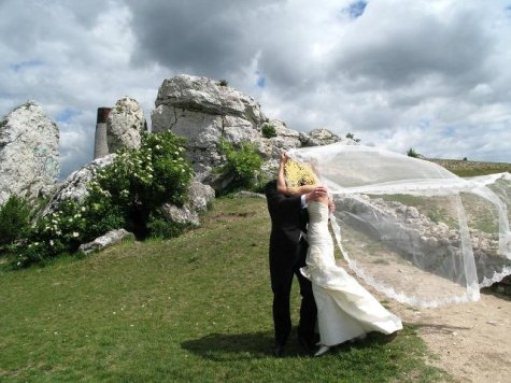
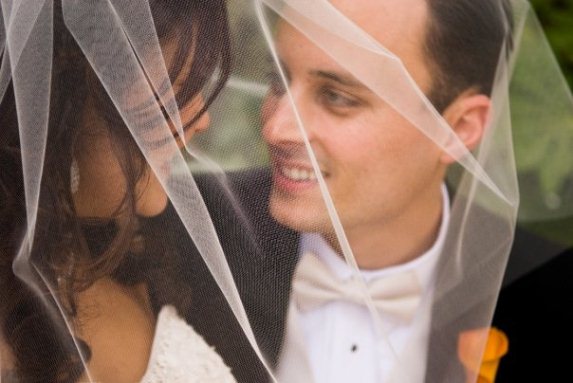
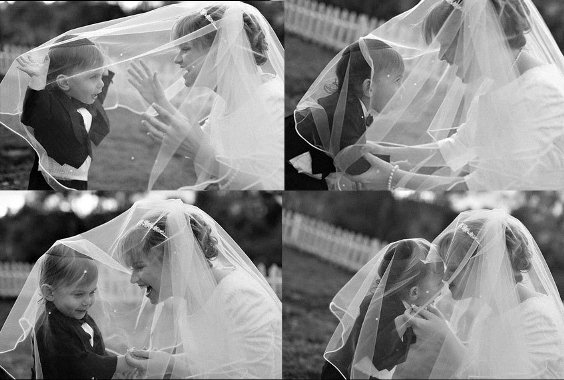
You and your beloved will be taking a day’s worth of photos together. From posed shots to candid snaps, the two of you will get total paparazzi treatment and it’s your big opportunity to be fierce! Your veil can be a character in your photos, too! From romantic to playful, make sure to include your veil in your happy day. You’ll be happy you did… from head to toe. Here are some camera must haves to run by your photographer.

Image courtesy of eight20 photography

Image courtesy of Meghan Aileen Photography

Image courtesy of Jessica Claire

Image courtesy of Jessica Claire

Image courtesy of Brian Dorsey Studios

Image courtesy of Jennifer Bowen Photography

So You Think You Can Hora Dance

You and your groom got through the ceremony. The glass is broken. You spent time alone. The guests are enjoying cocktails. It’s time for your grand entrance. You’ll probably show off your first dance. And most likely, right after, you and of your closest family and friends will gallop onto the dance floor and the Jewish instinct kicks in “Fiddler On The Roof”-style: you and your wedding guests grapevine your way into a festive hora dance.

Dance has always been a part of the cultural element of Judaism, usually incorporated into celebratory occasions as early as Exodus 15:20, which was when Miriam led the women in rhythmic dances after the crossing of the Sea of Reeds from Egyptian slavery to freedom. Today, dance also inspires spiritual expression.

So, it’s no wonder that the hora is the norm-a at Jewish weddings. It’s a time to celebrate and honor traditions!

The hora, also sometimes spelled, horah, is danced in 6 beats, usually to the song “Hava Nagila”:

  • Form a circle with your guests and hold hands
  • Step out on your left foot
  • Put your right foot behind your left
  • Step out on your left foot again
  • Kick your right foot out
  • Kick your left foot out
  • Repeat until you’re pooped!

Have you ever mushed up a bunch of Yiddish-sounding words and faked the lyrics, because, really, you have NO idea what the words are? Admit it, you have no idea. Thanks to the Yentas, now, you can dance and sing the right words:

Hava nagila (Let’s rejoice)
Hava nagila v’nismecha (Let’s rejoice and be happy)

Hava neranenah (Let’s sing)
Hava neranenah v’nismecha (Let’s sing and be happy)

Uru, uru achim! (Awake, awake, brothers!)
Uru achim b’lev sameach (Awake brothers with a happy heart)

Uru achim, uru achim! (Awake, brothers, awake, brothers!)
B’lev sameach (With a happy heart)

Somewhere during the dance, your cousins or the fathers or even some shnockered groomsmen will grab some chairs, lift you up, and toss you around while you hold on for dear life. This makes for some fabulous photos! Word to the wise: Have your venue set aside two arm chairs near the dance floor just for this portion of the evening. Emphasis on the ARM chairs. You’ll want something to grab on to. Trust us!!

A mother or an aunt will probably toss a napkin at you. This is not because you have chicken skewer sauce on your face left over from cocktail hour. This is because there’s an Orthodox rule that women and men, including the bride and groom, cannot touch, therefore, dance together. When the bride and groom hold on to each end of the napkin, they can “dance” together up in the chairs without touching. Conservative and Reform couples usually incorporate this tradition in their hora dances due to its festive nature, even if they’re not having an Orthodox wedding.

And now we leave you with a video of a hora at a wedding by Perspective Video. It’s such a fun way to get the party started!

hora-chair-lift

Image courtesy of Next Exit Photography.

Three Arms A Charm

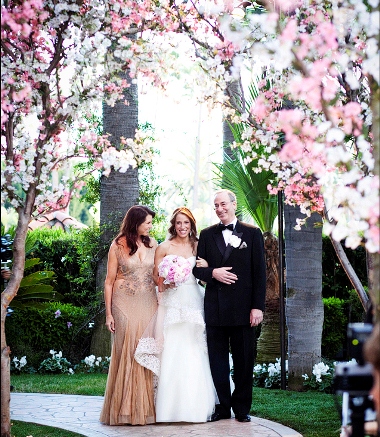
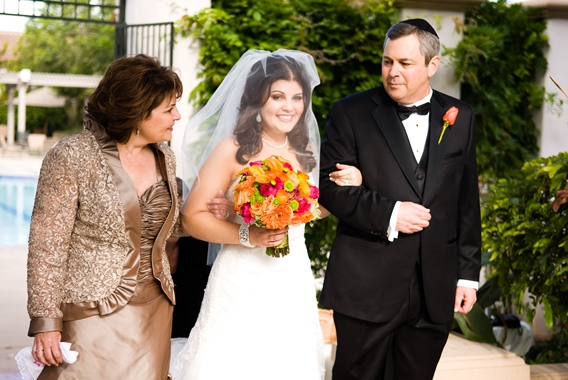
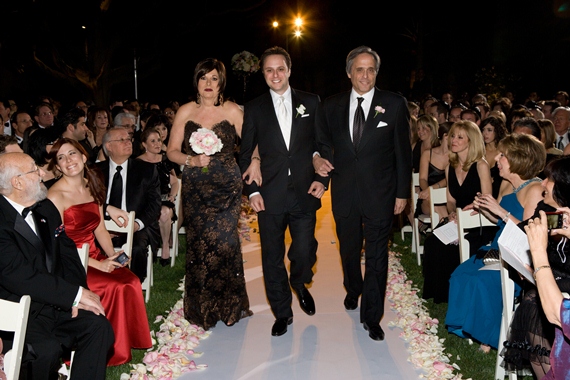
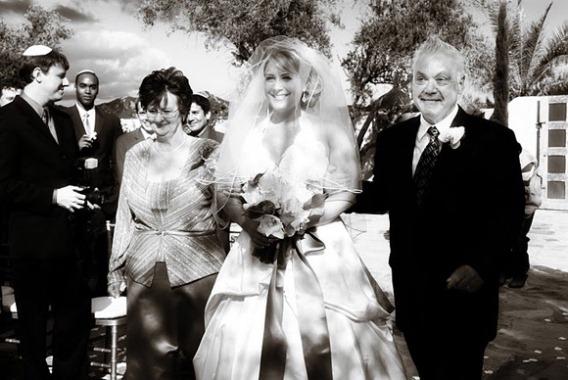
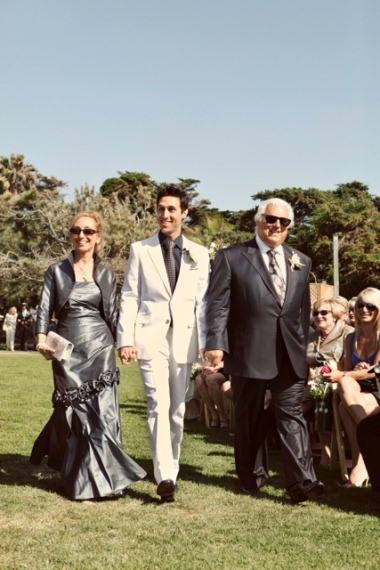
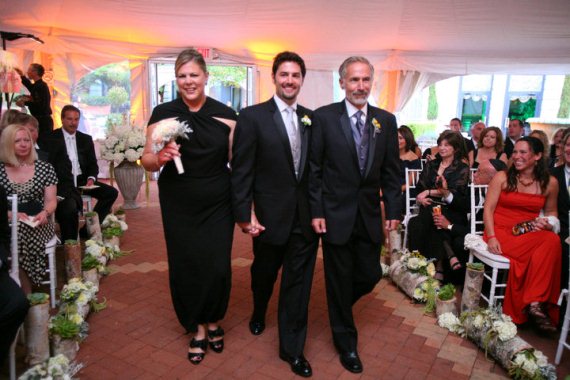
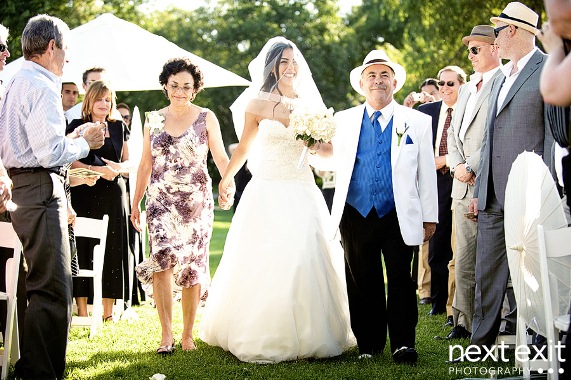
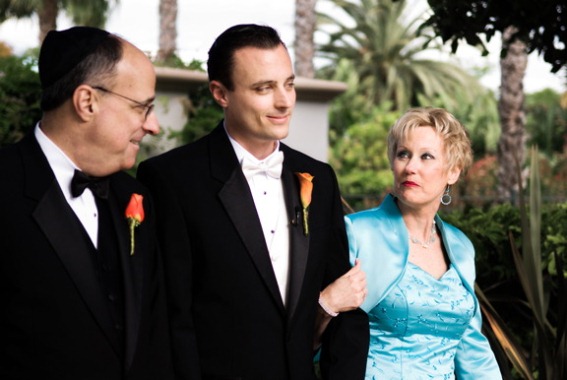
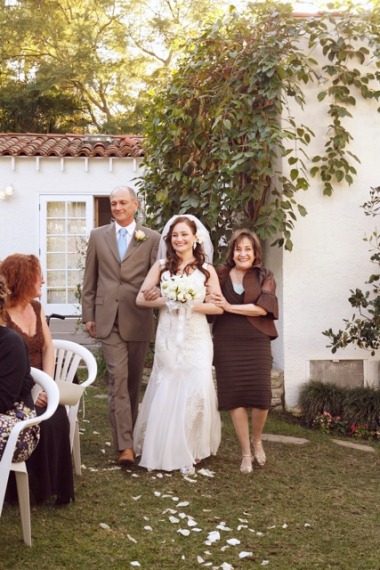
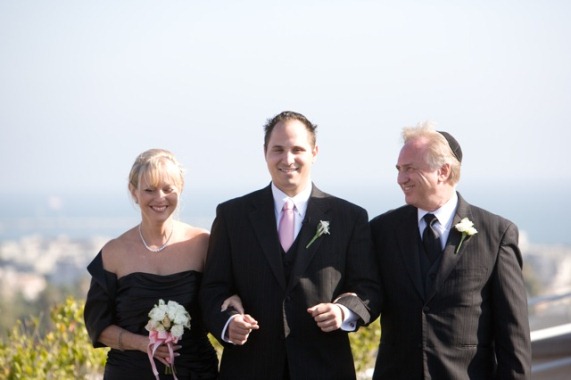
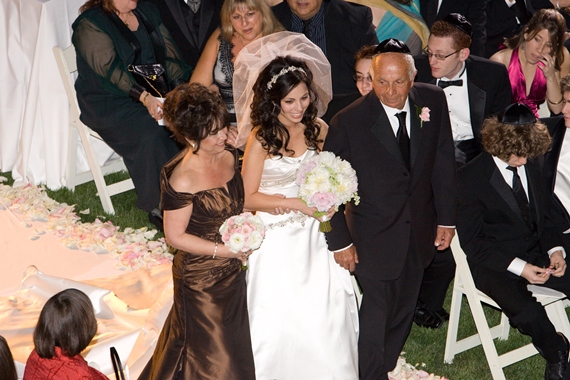
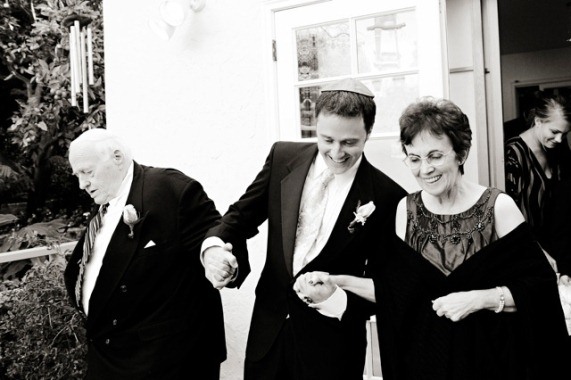
One of the main differences between a traditional Jewish wedding and a non-Jewish wedding is the wedding processional. A Jewish wedding needs a little wider of an aisle to accommodate the bride and groom as they walk down the aisle… with their parents.

It is a Jewish custom that both the mothers and fathers of the bride and the groom walk their children down the aisle. Naturally, if a parent is deceased or if there is a step-parent situation unique to the wedding occasion, that’s a different story and one to discuss with your partner and rabbi.

We love this beautiful tradition, as a child is still a child, even on his or her wedding day. Together, the parents raised the child to become an adult who is now taking on the mitzvah of marriage. It’s so nice that the groom doesn’t make the walk alone down the aisle; his parents showed him the way to be a man and on his wedding day, they show him the way to meet his bride under the chuppah. Likewise, the relationship between a mother and daughter is so unique and special, that it’s only fitting that the mother joins the father as they both link arms with their daughter in her wedding gown.

These are the tender moments that always send me to a waterfall of happy tears every time I attend a Jewish wedding. Here we’ll share with you some of these priceless, milestone moments. The photos give you a peek into this miraculous and lovely relationship between parents and their children. While I love looking at the the beautiful aura of the bride or the dashing and in-love groom, admiring the parents during one of their proudest moments gives me goosebumps! Grab a hankie!

Image courtesy of Kim Fox Photography

Image courtesy of eight20 photography

Image courtesy of Dahl Photography

Photo courtesy of Kim Fox Photography

Image courtesy of Sweet Monday Photography

Image courtesy of Jay Kelly Photography

Photo courtesy of Next Exit Photography

Image courtesy of eight20 photography

Image courtesy of Sweet Monday Photography

Image courtesy of Next Exit Photography

Image courtesy of David Michael Photography

Image courtesy of Sweet Monday Photography

Image courtesy of Dahl Photography

Image courtesy of Sweet Monday Photography

Image courtesy of Next Exit Photography

Ask The Yentas: Kipah & Ketubah Names

Recently, two very reasonable questions came my way and I thought they’d be great to share with all of Yentaland. These questions crossed my mind when I was planning my wedding as well, so I’m sure there will be readers who are looking for these answers as well.

First, a message from Melanie:
Hello Yentas!
I am so glad I finally found you! I am trying to order the yarmulkes and I have no clue what to write inside. I don’t live in my home town so I can’t go to the drawer with all of the old ones in it. So do personalize them with:

“The Wedding of Bride’s First and Last Name & Groom’s First and Last Name” or should I just use our first names?
What goes inside? Please and thank you!
Melanie

Answer from The Wedding Yentas:
Hi Melanie!
It’s really up to you when you personalize the inside of your yarmulkes! It’s a personal preference. For my own wedding, I just included The Wedding of Alison & Bryan with our wedding date underneath. While it’s not wrong to include last names, you might not want to take up extra space and clutter the area with the 2 additional names. Plus, by the time people take them home to re-wear them, you will no longer be known as your first name and maiden name (exciting, right?!) and you will both have the same last name (mazel!). So, my suggestion would be to keep it to the first names. Nothing’s right, nothing’s wrong. Personal preference and that’s mine.

You can also include your wedding date below the names. You can use the American calendar like I did — May 25, 2008 — or you can include the Hebrew month, day, and year. You’d need to check to make sure you have it correctly, but it just depends on how Jewish you want to make it.

Good luck!!
Alison

Great question, right? Melanie, I hope that helped you!

Next, another question about last names, but this time it’s in regards to the ketubah.
On Facebook, Megan asked:

Ok this may be a dumb question but do I sign the ketubah with my maiden name or married name??

Answer from The Wedding Yentas:
Not dumb!! Totally reasonable question. Since you sign the ketubah before your chuppah ceremony (which also serves as your official civil ceremony), you’ll autograph the ketubah with your maiden name. All ketubah signers, as well as marriage certificate signers, should use their full names, and that includes the bride and groom. If you have a Hebrew name, be prepared to know what it is and sign that as well. If your Hebrew is a little rough or non-existent, your rabbi should be able to help you write the letters. Always check with your officiant for specific directions.

So there you have it! Two totally reasonable questions with answers that hopefully help some fellow Yentas in distress.

If you have more questions, feel free to email them to alison @ theweddingyentas [dot] com and I’ll be happy to help you! I’m a geek, so I normally know the answer but if I don’t, I’ll find out for you. Consider The Wedding Yentas your personal wedding concierge!