Category Archives: Jewish Traditions

The Gift of Lev

A bride has a lot to think about during the wedding planning process, and one of the more difficult ideas to swirl around is choosing a gift for her groom. It’s certainly not mandatory, but many couples decide they’d like to present each other with a wedding day present. In future posts, we’ll talk about options for many kinds of gifts, but did you know that there’s a traditional gift from the bride to the groom?

It’s a wedding custom that a bride gives a tallit to her soon-to-be husband just before the ceremony. The tallit, or prayer shawl, symbolizes that the man is off the market or spoken for. It serves as a sort of right of passage, which is also why many young men receive a tallit when they become a bar mitzvah. The wedding day tallit marks a new milestone in the man’s life as he takes on a new purpose as husband.

As with many Jewish traditions, there is a Torah-associated reason for the tallit gift. In Deuteronomy, the commandment for a man to wear tassels (the tallit) precedes the portion that begins, “When a man takes a wife…” The tallit and the ring that the groom wears are also related on the same level. Just as the wedding ring is a cyclical representation of never ending love, so is a tallit as it is wrapped around the groom as a reminder of spirituality and devotion to his bride.

I don’t profess to be good at math or numbers, but there’s also a “ah ha!” connection between the tallit’s tassels and love. This is a number game that even I can wrap my head around. Get this: On a tallit, there are eight strings in a tassel. There are four tassels on a tallit. A flashback to 3rd grade math and a simple computation will tell you that there is a total of 32 strings. Now, in Judaism, numbers have meaningful significance, usually symbolizing concepts or notions. The number 32 happens to be the numerical value of “lev” which means heart. Therefore, when a husband wears a tallit, he is absolutely wrapped in his wife’s love. Now if that isn’t an interesting yet romantic reason to gift a tallit to a groom, I don’t know what is.

Even if your groom doesn’t intend to wear a tallit every day, this wedding gift will always have special significance when it is taken out to be worn on future Shabbats and high holidays you spend together as husband and wife. Those occasions will be just a little sweeter as you look at the tallit and think back to your happiest day.

Don’t Go to Jail for a Crime Against Your Veil

On Monday, we talked about the bedeken and the symbolism behind the bride’s veil.

So now we are dedicating a whole other post to veils, making mention of tips, styles, and photo must-haves!

Camo is a No No
If you choose to wear a detailed wedding gown that sparkles with beading or has serious texture like lace, consider wearing a veil that doesn’t clash or hide those elements. What a shame it would be to select your dream dress and then cover it up with a veil that hides jewels or fancy buttons. An elbow-length veil will still serve its purpose but then also not upstage your dress.

Caw! Caw! Wear a Birdcage
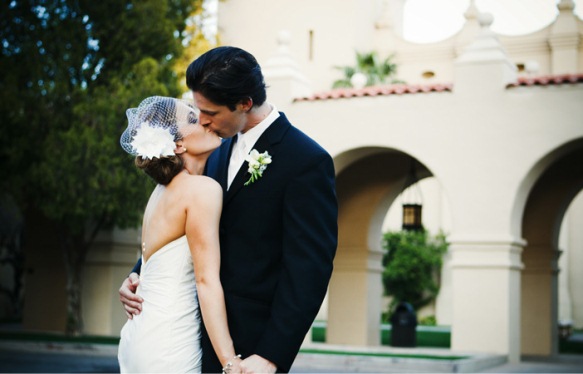
For serious drama or a vintage look, the birdcage veil is a classic. If you want a more traditional veil for your ceremony, you could always model a birdcage piece for photos or the reception. It’s a super-chic look that many brides love, but think they can’t pull off!! Just make sure your dress is in the same category of style. A very full and conservative gown might not mesh (haha, get it?) well with a birdcage veil, so go with a dress that’s sleek or sexy or vintage.

Image courtesy of Holladay Photo

Can’t We All Just Get Along?
Don’t let your dress fight with your veil. Instead, they should complement each other! If your dress has beading or pretty, sparkly doodads on it, then your veil should lean toward the plain side. If your dress provides simple beauty without jewels or lots of lacy additions, then your veil can have elaborate extras. But if you combine both, the veil and the dress will end up in a one-upping competition and you’ll lose the splendor altogether. This goes for your jewelry, too. The more detailed your veil is, the softer and simpler your jewelry must be. All three elements should definitely play well together, and not against each other. There is definitely such thing as too much of a good… bling.

Color Me Bride
Make sure to color coordinate! While you don’t want your dress and veil details to be too matchy-matchy, you definitely have to make sure your colors are! If you are wearing an ivory dress, it would be no bueno to wear a diamond white veil. Many bridal salons will offer you swatch samples to compare and be sure that both items match. There is no wrong color — it’s up to you to decide what works for your style and skin tone — but you definitely want to be sure that the color is consistent for both beauties.

Veil Types
You’d think that a drapey piece of mesh would be a no-brainer shopping experience. Wrong! If you’ve just started shopping for a veil, you’ll start to hear lots of body part-centric lingo that you didn’t know could describe a wedding day accessory. Basically, many veils are described by the body part they reach. There’s shoulder length, elbow length, fingertip length, knee length, and floor length (not a body part, but toe-length just sounds weird). Then, there’s church lingo that describes two other varieties of veils and let’s face it, Hebrew school didn’t prepare you for that kind of information. Chapel length veils extend to the floor, about seven feet from the top/head piece. A cathedral length veil trails anywhere from one to three yards behind the dress. The most formal style of veil is the cathedral length.

Bride, Groom… and Veil Photos?
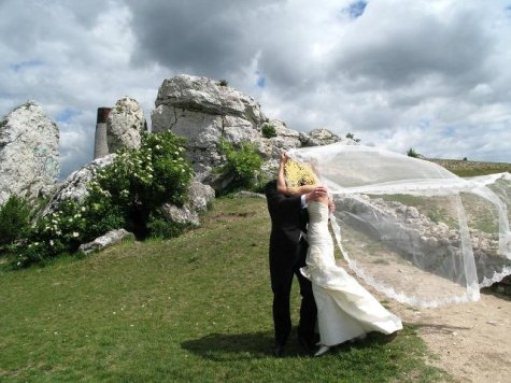
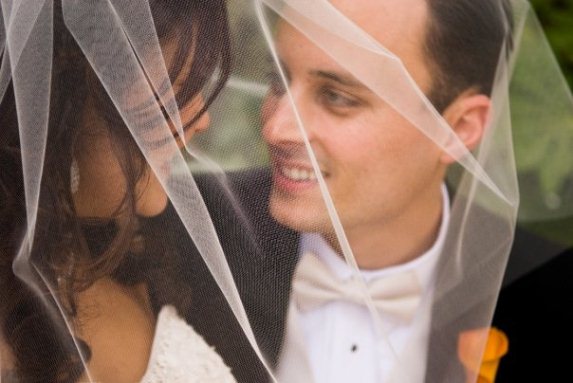
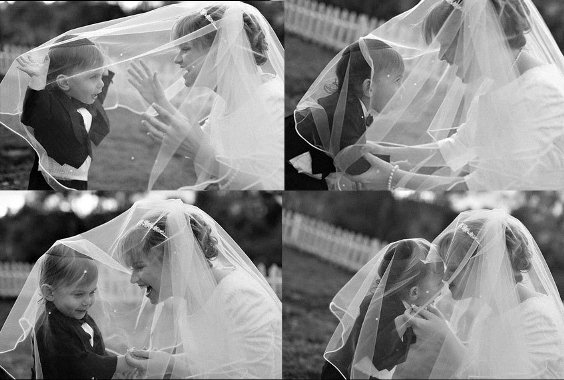
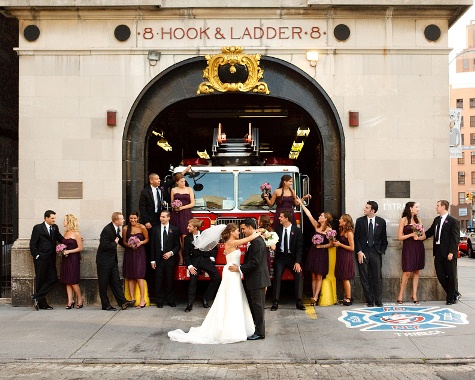
You and your beloved will be taking a day’s worth of photos together. From posed shots to candid snaps, the two of you will get total paparazzi treatment and it’s your big opportunity to be fierce! Your veil can be a character in your photos, too! From romantic to playful, make sure to include your veil in your happy day. You’ll be happy you did… from head to toe. Here are some camera must haves to run by your photographer.

Image courtesy of eight20 photography

Image courtesy of Meghan Aileen Photography

Image courtesy of Jessica Claire

Image courtesy of Jessica Claire

Image courtesy of Brian Dorsey Studios

Image courtesy of Jennifer Bowen Photography

Put the Pizzazz In Your Mezuzah

As you begin to build your life together as a married couple, consider installing a new mezuzah on the doors of your home.

A mezuzah is a piece of parchment inscribed with specified Hebrew verses from the Torah (Deuteronomy 6:4-9 and 11:13-21). Included is the Shema prayer: “Hear, O Israel, the LORD our God, the LORD is One.” The parchment is typically protected inside a cover or case that’s usually decorative.

It is actually a mitzvah to affix a mezuzah to the doorframe of a Jewish home. Some households believe it is Jewish law to affix a mezuzah on every doorway in the home (except for doorways leading to spaces that are too small for actual rooms (bathrooms, closets, etc.). Other households believe it’s only necessary to place a mezuzah on the front doorway. Depending on your affiliation, you and your rabbi may decide what works best for you. The parchment created and prepared by a scribe who has had years of careful training, and the verses are written in black indelible ink with a special quill pen. Then, the parchment is rolled into a thin tube-like piece and placed inside the exterior case.

Since your wedding day is a symbol of a new life and new start, it just seems fitting that you and your new partner should enjoy another mitzvah and milestone moment as you start a new family circle. The mezuzah can be plain or artistic. Either way, it should be an expression of you as a couple, customizing your home with warmth, health, and happiness.

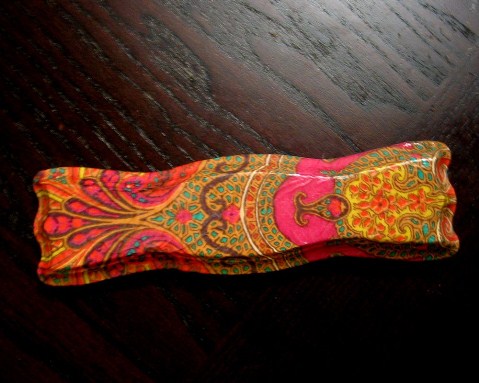
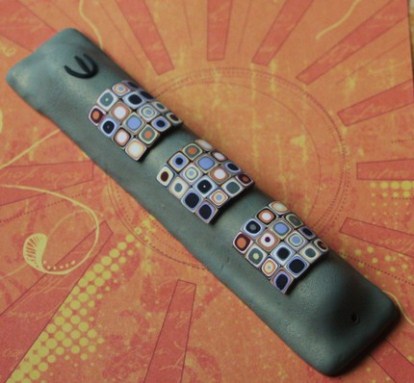
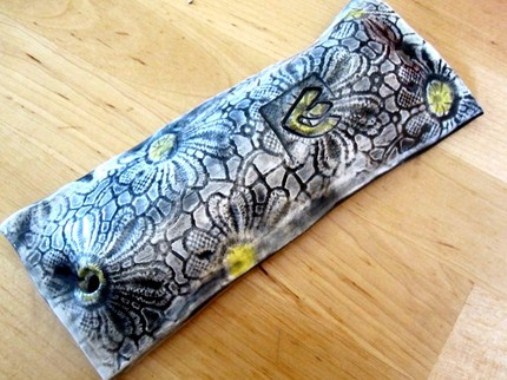
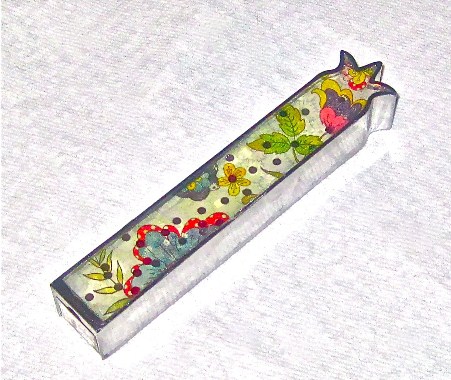
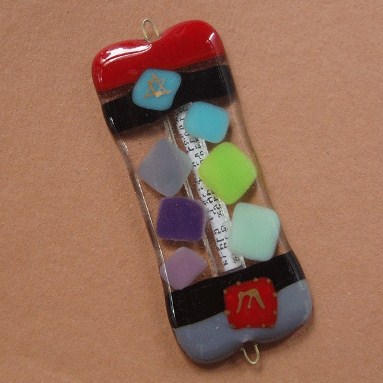
Here are cool mezuzahs that may be inspiring:

Mezuzah by Etsy seller Meravelous

Mezuzah by Etsy seller PolyAndClayed

Mezuzah by Etsy seller renarossner

Mezuzah by Etsy seller rkisuf

Mezuzah by Etsy seller Minjean

Make Fireworks at Your Wedding

We’re still celebrating America’s birthday, so we’ve prepared a July 4th themed wedding because you can never have enough USA love!

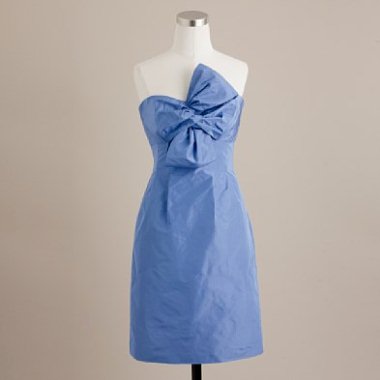
The United States has two beautiful oceans. From Atlantic to Pacific, J. Crew bridesmaid dresses look great on every bridesmaid! We love this getup thanks to the bow and the ocean blue hue!

Silk taffeta bow monde dress from J. Crew


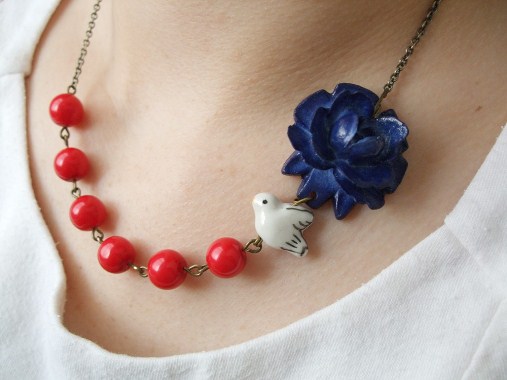
This necklace screams chic Jewish bride-to-be and would be great for pre-wedding celebrating at a rehearsal dinner! Birds are the “it” icon in fashion right now, the flower adds hip femininity, and the colors pay homage to patriotic spirit!

Nautical Escape necklace from Etsy seller RachelleD


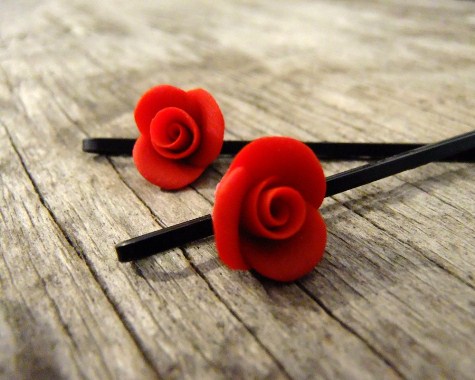
Celebrate America from head…

Vintage Inspired Rose Hairpins from Etsy seller LarqueByjason


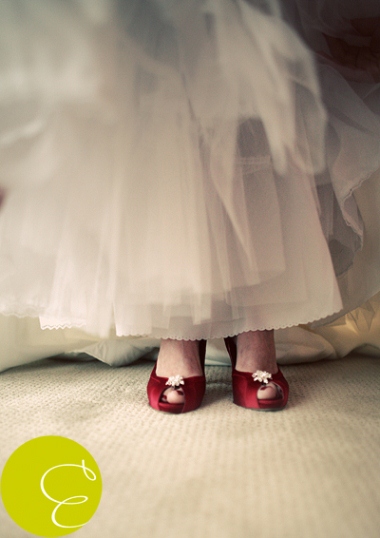
to toe!

Image courtesy of Eleise Theuer Photography


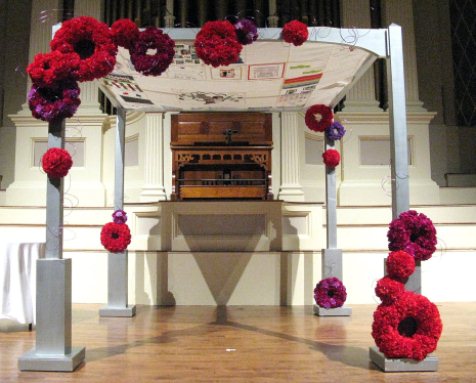
Your first home together is your chuppah, so in honor of our country, you could create a floral decor that’s inspired by America’s colors. This chuppah created by Sprout Flowers incorporates red and purple florals along the frames. The rings of flowers not only look cool, but symbolize the continuing and never ending love of marriage. This is a great example of a modern and clean chuppah that also complements the overall style of the wedding.

Image courtesy of Sprout Flowers


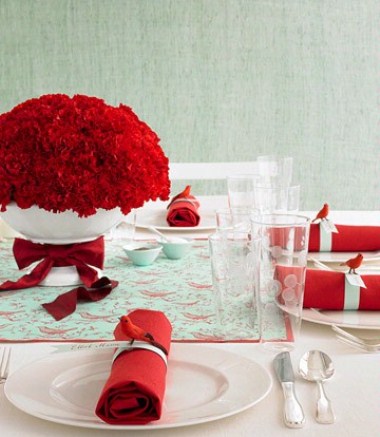
Your table scape can be a breathtaking sea of red, white and blue that looks modern and elegant at the same time! Consider red flowers with blue and white accents. Go with powder or aqua blues to pair with the red. This table scape by Martha Stewart is really fresh and playful!

Red flowers in a white urn, with a lacy aqua and white mat. Add candles for extra sparkle!


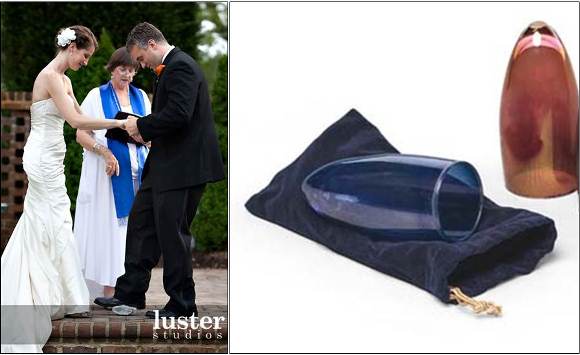
For a little celebratory explosion, you can mark the start of your marriage by breaking blue and red glass under the chuppah! Save the glass from the pouch and put it inside a mezuzah or a frame. Many Judaica shops sell these commemorative items.

Breaking the glass image courtesy of Luster Studios.


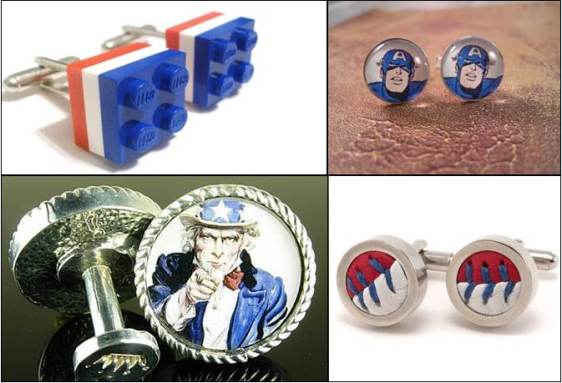
Even the guys can enjoy the patriotic theme of your wedding day! Consider these super cool cufflinks for dads, groomsmen, and of course, the groom himself. Clockwise, the goods are: Patriotic Lego Tile from Etsy seller Cufflinks, Captain America Vintage Image Cuff Links from Etsy seller blinkphoto, Uncle Sam 4th of July from Etsy seller wmdean, and American Baseball Cufflinks from Etsy seller qacreate. We Want YOU to love these cufflinks!

Lego, Captain America, Uncle Sam, and leather baseball cufflinks all make great fits for the men of your wedding!


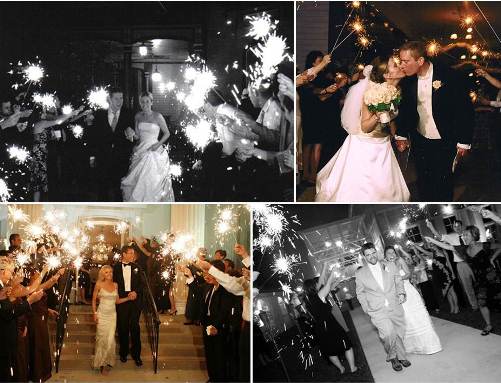
We can’t think of any other way that screams “Go America!” more than sparklers! Create a magical grand exit with sparklers provided for your guests! We love the go-to wedding sparklers company called, quite appropriately, Sparkle. They offer a variety of sparklers lengths and a thorough information guide with tips and facts about their products. We love that they showcase creative ideas for displaying sparklers; they really are the epitome of character and fun! On the most magical night of your life, you totally deserve to exit in a sparkly, big way!

Images courtesy of Sparkle

From The Expert: Ketubah Shopping

Since The Wedding Yentas launched about two months ago, many brides have asked us to do a post devoted to the process of selecting a ketubah. After much research and info gathering, we decided it would be best to hear it from the talented ketubah artist’s mouth! She’s so talented, that she was Yenta Alison’s ketubah artist! We love her work and we are so excited to present a guest blogger this week who is the expert in all things ketubah! Thanks, Rachel Deitsch of New World Wedding, for sharing your expertise:

One of the things that dawned on me when I started making ketubot was that pretty much everyone who needs a ketubah is a first-time customer! There are many many variables, which can be dizzying, but fortunately there are people (like me) who do this every day who can help guide you through the process. I’ve broken this guide into chewable chunks for easier digestion; please wait an hour before swimming…
How do you find the right ketubah design for you?
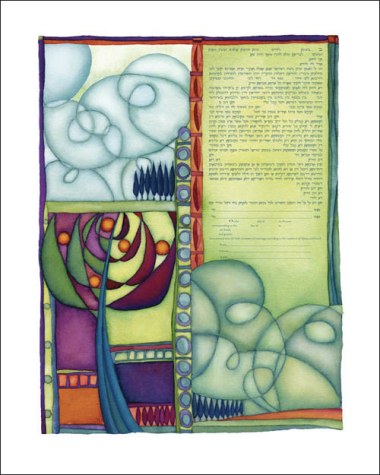
Deciding on the right ketubah design an extremely personal process- it’s the one factor that will depend solely on your own taste and gut. Traditionally the ketubah belongs to the bride, but of course today both parties decide together what speaks to them. There are so many styles of ketubah- from formal and florid to minimal and modern- that is something you as a couple will have to choose.

I’ve found that couples look for something in the design that speaks to their story. That is a very exciting part of the ketubah business- when something I’ve made has an entirely new meaning for the person choosing it.

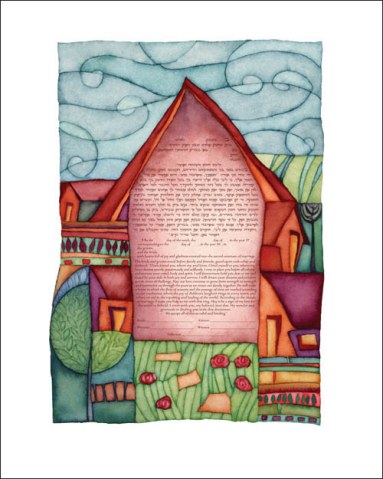
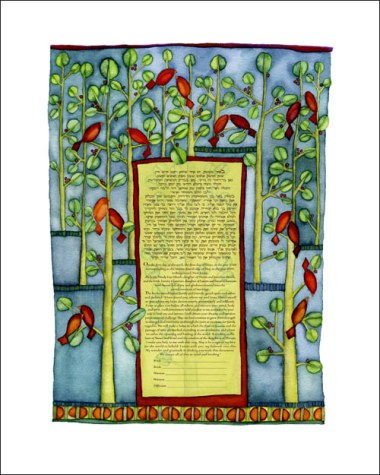
There is a traditional visual vocabulary in ketubah art that you will become familiar with as you explore different artists’ work. They are generally fairly easily interpreted- plants, trees, fruit and flowers for growth and fertility; birds are blessings, as is water. I also use a few non-traditional motifs- ladders speak of aspirations, cottages of the home you build together. As you poke around you’ll find the style and image you really connect to.

Custom Artwork
Commissioning a custom ketubah can be a very expensive proposition. Some artists specialize in custom ketubot, but most sell prints of existing work. Keep in mind that commissioning a ketubah is like commissioning any other artwork- it’s expensive and you are not 100% in control of the end product. Of course, that can be very exciting and gratifying- knowing you have the only one of its kind in the world, but be prepared to give up some control and to trust the artist.

If you like an artist’s style, one option to consider is asking if an existing design can be modified. I don’t generally accept commissions for custom work, but I always try and figure out a solution to a clients’ request. We creative types can be surprisingly, well, creative- so ask!
Where to Buy?
You can find pretty much every ketubah artist and style imaginable online of course, and I think that’s how many ketubahs today are sold. Most ketubah artists will sell both through a ketubah reseller — a site that carries many artists — and their own personal site. There are good reasons to go either way. With a reseller you have a variety of artists right in front of you. An artist’s site will get you in touch with the person actually making your ketubah, so if you have a special request, it can be more easily accommodated. Most web sites will offer to send a free paper-print sample so you can feel the weight of the paper and see the true color before you buy- if you don’t see that offer — just ask.

There are still many people who prefer to buy at a brick and mortar store, either to support local businesses or because they want to see the print before purchasing. Many customers will research online then go to their local store to make the purchase. Even if the store carries the artist you like, they probably don’t have every design sample on hand, but they can usually get any design by an artist they carry. It’s a bit trickier if they don’t carry the artist at all. Some artists will sell a la carte to a store that contacts them, but many will prefer the customer buy directly through them if there is no prior relationship with the store.

The Text
This is where it can get tricky for a lot of people. The design you choose of course says a lot about you as a couple, but the text literally spells it out, doesn’t it? It can be daunting to choose the right words to express what you are thinking and feeling.

Traditional Texts
If you are Orthodox or Conservative and/or are being married by an Orthodox or Conservative rabbi, you will have pretty firm instructions on what the rabbi will accept on the ketubah.

I am often asked about including an English translation of the traditional Aramaic text… until I show the bride and groom the translation. It’s a pretty dry legal document and I’ve yet to have any couple wish to print it on their ketubah. What many couples using the Orthodox/Conservative texts will do instead is add a paragraph either of their own or, since those text are pretty lengthy, one that simply states the basic facts of the wedding: names, date, place.

Orthodox, Conservative: What’s the Difference?
I’m often asked about this. The difference between those two texts is an additional paragraph (in Hebrew, not Aramaic) called the Lieberman Clause, which was added by the Conservative movement in the 1950s.

Other Texts

Here’s where it gets wild and woolly. If you are not going to opt for a traditional text, the world is your matzoh ball. Most modern ketubah texts are written or commissioned by the ketubah artists and reflect the sentiments of a contemporary couple, emphasizing mutual understanding and support. There are a great deal of interfaith and non-denominational texts as well, which are respectful of both parties’ traditions. As you read through them, you’ll likely be inspired to discussions about what your expectations and hopes are for your marriage. It’s a wonderful exercise!

To me, that’s really the point of these texts; to make those conversations happen. The beauty of the ketubah is that it’s there every day to remind you of your intentions in your marriage. It’s the same as having a mezuzah on your door, which reminds you that your home is a place of your particular values.

It can be tough to set these ideals down on paper and most couples are very happy to have something the can choose out of the box.

There are lots of really beautifully written texts that absolutely fit the bill, but here’s something to keep in mind: you might like the design of one artist and the text of another. Most artists, especially when asked nicely, will readily allow their texts to be used in another’s artwork for one-time use. Some might ask for a small license fee. Also, if you are working directly with the artist, he or she will generally be open to tweaking their text. For instance, one of my popular texts refers to future children. Some couples know that this is not their plan and I’m happy to remove the sentence — no worries.

If you are blessed with a way with words and want to write your own, it’s a great way to go. Ask the ketubah seller or artist about the parameters for custom texts. There’s generally a word count limit. I offer a translation service as do most other ketubah sellers, if you want your text in both Hebrew and English. I’ve done Spanish, Norwegian and Chinese as well, so always ask if you have a special circumstance!


Personalizing Your Ketubah

When you order your ketubah you’ll have the option of personalizing, filling it in. That means your personal information — the wedding date, your and your parents’ names, the place of the ceremony — will be incorporated into the text. Some artists who are also calligraphers do this by hand on a pre-printed ketubah. I don’t calligraph (is that a word?) so I lay out the texts to order, then print everything — text and artwork — together. I like this approach because the whole text is laid out to fit perfectly in the space.

If you are personalizing, every ketubah seller has a form to fill out. It’s simply the names, date, and place of the wedding. You are asked for your full name, Jewish name, if you have one, and your parents’ first names.

Here are some issues that come up regarding the personalization info:

If you do not have a Jewish (Hebrew) name, what do you fill in?
If there’s no Hebrew name, I will transliterate the English name. I never make up a Hebrew name for someone; there is really no standard parallel between English and Hebrew names, although some, like David or Rachel, would seem obvious. I never assume or presume.

Do you need your parents’ FULL Hebrew name (including THEIR parents’ names, i.e. Rachel ‘bat’ Sara)?
No, that is only for the couple. The parents are just called by first names in Hebrew, and in English generally first and last.

What if for personal reasons I do not wish to include my parents in the ketubah?
Like everything else here, it’s your choice. You may want to consult with your rabbi for Orthodox and Conservative, but I’ve seen omissions there as well.

Why am I being asked if this is my first marriage or if I am a convert?
This is only applicable to the Orthodox and Conservative text (and only applicable to the bride). It has to do with the way the wording changes with the bride’s “status.”

Why am I being asked about my “tribe?”
If either of the couple’s fathers is a Levite or Cohen — something your rabbi would most likely know — then it is mentioned in the ketubah as part of their Hebrew names.

You don’t have to know the Hebrew spelling for place names or the Jewish calendar date of your wedding — that is all part of the fill-in service.

The Rest of the Process

Here’s where I can’t really speak for anyone but myself, but I’m happy to clue you in to my methods. I imagine others work pretty much the same way. I generally tell folks to allow about 4 weeks from order to delivery, but I’ve done a fully personalized ketubah in much less time. It’s mostly for your own peace of mind to leave plenty of time. Once you’ve settled on where you’re going to buy your ketubah and what the text will be, you’ll get your information form from the seller or artist. Many couples ask their rabbi to help with this. When you send it in, I use the form to fill out the text in Hebrew and English and send you a pdf to approve. It’s a good idea to run this past your rabbi or officiant. When any changes or corrections are made and the text is approved, I lay it out in the artwork and print.

As I said, it’s a lot for a first-time (or any) ketubah buyer to absorb, so give yourself plenty of time to look around and don’t be shy about asking lots of questions.

Please feel free to get in touch with me with any burning issue I may not have covered here.

Rachel Deitsch is the artist behind New World Wedding. She also creates beautiful jewelry, invitations, and home decor pieces. She can be reached at rachel@newworldjudaica.com or visit her >website for more information.