Category Archives: Jewish Traditions

What Yichud Is All About

I endearingly called May 25, 2008 The Wedding Olympics. No one was competing for any scores. There was no torch to light and pass. A Beatles medley played in place of national anthems. However, the day was full of events that had us leaping from place to place and it was tiring. We made it through on adrenaline and love, so the long jumps and the synchronized swimmings and badmintons of the day did not feel too exhausting. So as true athletes do (ohmygosh, I just had the audacity to compare my husband and myself to athletes… true ones, even), we basked in our glory and winnings (each other) and enjoyed some nice, quiet alone time after the ceremony, otherwise known as the yichud.

I’ll explain the traditional significance of the yichud, but I’m telling you now, that’s not exactly what we did!

The yichud translates in Hebrew to the word seclusion. Traditionally, unmarried men and women should never be secluded together so, in theory, the wedding day is the first time this ever happens between the bride and groom. This law came about after the rape of King David’s daughter when she was left alone with her half brother. It was then that David and his high court extended this prohibition to all unmarried girls. Typically, the laws of yichud are followed by Orthodox Jews but all Jews may interpret the laws to fit their ceremony or beliefs. In early historical times, the yichud was when the just-married couple would consummate the marriage and witnesses would be there to guarantee privacy and verify that it indeed happened because technically, this was a legal and required act.

Fast forward to 2012. Modern day traditional brides and grooms leave the chuppah and go directly to a private area or room for their yichud. For couples who chose to fast on their wedding day in order to start their life anew, this is when they would also break the fast and exchange gifts. Typically, the bride will bless the groom, saying “May you merit to have a long life, and to unite with me in love from now until eternity. May I merit to dwell with you forever.”

Not every modern Jewish couple chooses to enjoy a yichud after the ceremony, and that’s okay, too! Some just want to get right to the party or have to continue with photographs. My groom and I chose to do a very short and sweet yichud and it was one of the highlights of our day. Those ten minutes marked the first time we got to really talk and rehash our mornings and afternoons when we were apart. And we reminisced about the ceremony and the vows we said to each other and how the weather perfectly cleared up as we left the chuppah to “Here Comes The Sun.” We sat in a garden 50 feet away from our flower-kissed chuppah, hand in hand, excited for the kick ass party that was about to start inside, and gushed about the gold medal event that had just taken place: becoming husband and wife.
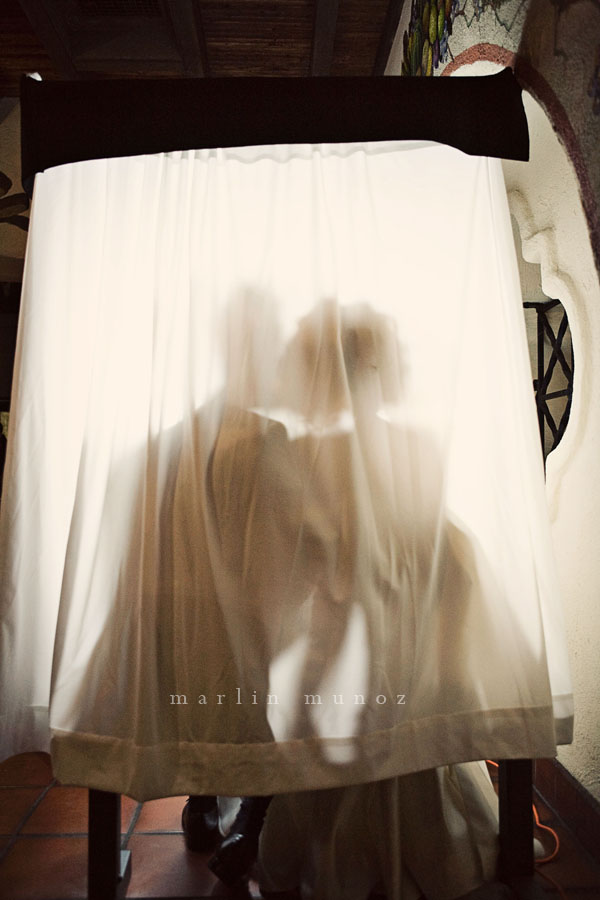
Image courtesy of Marlin Munoz

Ketubah.com Plays: Name That Ketubah!

Ketubah.com is probably one of the first places a couple browses while searching for their perfect Ketubah. Ketubah.com has a fabulous selection of all different kinds of art that speaks to many individual tastes and affiliations. You can literally search by color, theme, price range, artist… and the available texts can provide meaning for anything from an anniversary to an interfaith wedding to a orthodox wedding. You can even submit your own text if you have something else up your sleeve. Sizes and paper stock are flexible and you can even have it rush shipped if the Ketubah is a last minute detail you just remembered — oops!

Ketubah.com customers are pleased with their purchases which is always fabulous to know, but what’s even more interesting is learning about the people at Ketubah.com who work so hard to provide these beautiful and meaningful works of art! Who are the pros and what do they think about the Ketubah choices on the site?

Three members of the Ketubah.com staff offered to share some interesting insight on some of their personal favorites about Ketubah selections.

******************************

Kevin, Director of Product Development and Marketing

Q: What is your favorite style of art?
A: My favorite style of art is abstract. I love the work of Jackson Pollack because that kind of vibrancy really speaks to me. The Ketubah design Abstractions by Laya Crust speaks to me in the same way. Although the design is made up of Hebrew lettering, it is so abstract that at first glance it looks like a wonderfully vibrant design.

Q: What colors strike your fancy?
A. I like sedate color palettes. Lots of earthy tones and muted colours. I like the blues, reds, and browns of Abstractions by Laya Crust and Fall Bouquet by Naomi Broudo.

Q: What’s the idea location to hang a Ketubah?
A: Although I don’t currently have a Ketubah, my favorite place would be in the living room. My living room is a place of gathering for family and friends, the place I spend most of my time in the house. Because the Ketubah is not just a work of art but a reminder of our commitment, I’d like to display it where it is most visible to me.

Q: If you could choose a Ketubah for any celebrity, who would it be?
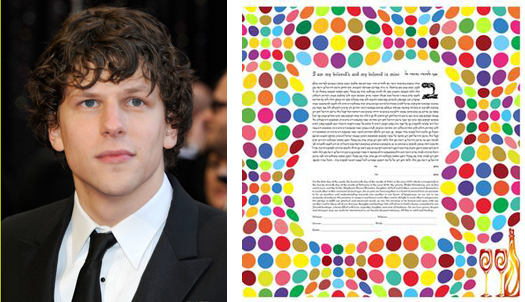
A: I would choose Harmony Colorful by Ruth Rudin for Jesse Eisenberg. He’s pretty quirky and a bit out there and I’d think he’d appreciate the whimsy and retro feel of this design.

******************************

Tani, Marketing Manager and Customer Service
Q: What is your favorite style of art?
A: Impressionism, I like bright and bold colors and outdoor landscapes.

Q: What is your favorite color combo or palette?
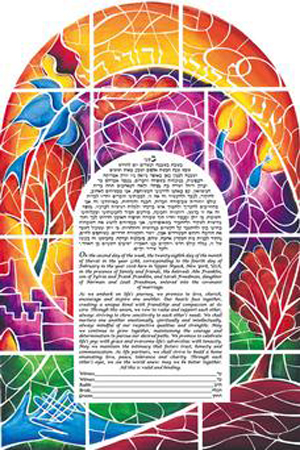
A: Turquoise and magenta such as Stained Glass Champagne by Lee Loebman.

Q: What would be the perfect place to hang a Ketubah in the house?
A: In the living room. I think the bright colors would add a nice touch to the décor in addition to reminding my husband and I of our commitment to each other on a regular basis.

Q: If you could recommend a Ketubah for a celebrity, who would it be?
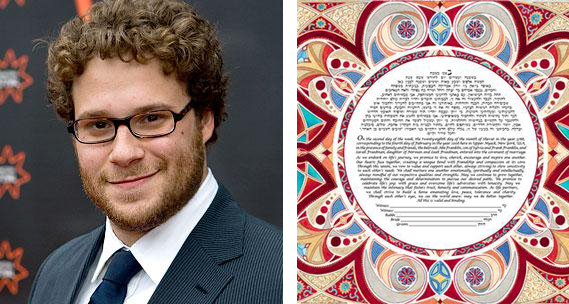
A: I love Seth Rogen! He is hilarious and I would love to find out more about his ketubah style. My recommendation would be Symphony by Adam Rhine.

******************************

Shira, Customer Service Manager

Q: What is your favorite style of art?
A: I love Post-Impressionist art such as Firefly by Judith Joseph.

Q: What is your favorite color combo or palette?
A: Blues and greys such as Take a Bow — Sky by Michelle Rummel.

Q: What is your favorite place to hang a Ketubah in the house?
A: In the living room, so anyone who comes in can admire it.

Q: If you could choose a Ketubah for a celebrity, who would it be?
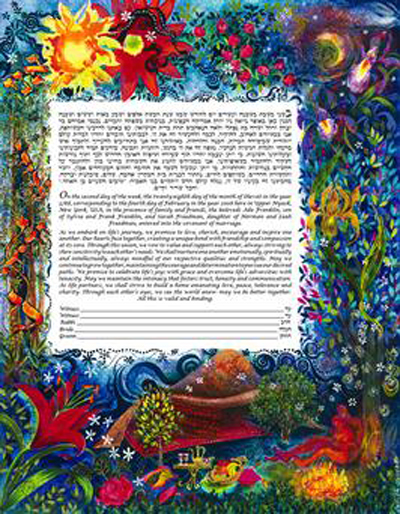
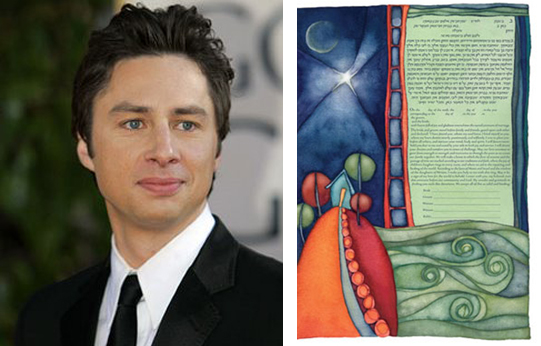
A: I would choose a Ketubah for Zach Braff. I used to love watching him on “Scrubs.” He is so funny and also down to earth. I know he loves his family and chooses to be near them when he is not abroad. I would choose the Ketubah Seaside by Rachel Deitsch for Braff. It shows both home and water (the ocean he crosses to work in London now) which are the things that are important to him, but at the same time [the piece] is whimsical and fun.

*** This post was sponsored by Ketubah.com, a proud partner of The Wedding Yentas. ***

From The Expert: 3 Tips For Creating Your Own Interfaith Ceremony

Daniel Sroka is the artist and owner of Modern Ketubah. He creates modern fine art wedding ketubahs from his abstract photographs of flowers and leaves for interfaith, Jewish, and multi-cultural couples. The first ketubah he ever made was for his own wedding. He and his then-fiance, Cara, wanted to make sure they loved the artwork to proudly hang it in their home, and they also wanted to be sure that the text and symbolism was meaningful, especially as an interfaith couple. They decided that his fine art photography would be the ideal style to express their marriage, as many other ketubahs they saw while shopping were adorned with Jewish symbols, and did not match their taste or represent them equally. Since then, Daniel has successfully built a ketubah business that honors individual style and spirituality.

Interfaith weddings represent a beautiful moment: the joining of two families with different traditions into one. This gives interfaith couples the opportunity to create a wedding ceremony that not only appeals to them artistically, but also symbolizes how their marriage brings together their religions and backgrounds.

When my customers ask me for advice on how to create an interfaith ceremony, I usually give them a few pieces of advice:
(1) Make no assumptions about what should be in the ceremony.
(2) Be ready to compromise, discuss, and learn.
(3) Remember that while you are trying to honor your families and religions, be sure to create a ceremony that is meaningful to you personally.

Make no assumptions: We all grow up with ideas of what a wedding should look like, grounded partly in our religion and the weddings we attended as children, and partly in the glamorous depictions of Hollywood. But when you create your own ceremony, be ready to set these ideas aside and start from scratch. Don’t assume that your partner shares your same romanticized vision. What you consider essential to a wedding might be something that he or she can’t stand. So while these ideas can influence you, and help guide you, don’t assume that your wedding must follow those patterns.

Be ready to compromise and learn: I always recommend that a couple write down their ideas of what should be in a wedding, and then go through them step by step and explain to each other the meaning and importance of each. This is especially important for religious traditions that your partner may have no understanding of. Be patient, and be open-minded. When my wife and I did this, we began to realize that some traditions we originally considered essential really had no meaning once we tried to explain them. And other traditions we never paid attention to suddenly became very meaningful and important. So be ready to compromise, and be ready to learn how to balance each others’ needs, concerns and ideas. Creating this wedding is one of your first big challenges as an interfaith couple.

Artist Daniel Sroka and his bride with their interfaith ketubah he created.

Remember that the ceremony is about you: Families can put a lot of pressure on a couple, especially when they are interfaith. Consciously or not, your family will try to influence what should be in your wedding. This can be a good thing, especially when they help you understand and explain your traditions. But it can also become an unnecessary burden. Grandma won’t come to a wedding that doesn’t have a chuppah. Your father won’t be happy unless he walks you down the aisle alone. Aunt Sally insists that a valid wedding must be held in a church. Subtle demands and suggestions can start to overwhelm you! But don’t let these family pressures dictate what your wedding should be like. Remember that this is your ceremony, the start of your marriage. Your family is important, but they are there for you, not the other way around. Listen to their concerns, be don’t feel obligated to them.

While an interfaith wedding can often feel like a diplomatic mission between warring factions, it doesn’t need to be. It can really be a way to introduce both sides of your family to the traditions and religion of their new in-laws. When my wife and I got married, we created a ceremony that combined both her Jewish and my Catholic traditions, while also introducing some new traditions and ideas of our own. This combined ceremony worked to bring our two families together in a beautiful and special way. Each side could relate to part of the ceremony, and also share the experience of something new. We explained the traditions throughout the ceremony in simple terms so that everyone could appreciate the parts they weren’t familiar with. We worked carefully with our rabbi and priest to make sure the ceremony came together as a whole, and that no one felt left out or confused. And in the end, our families loved it as much as we did. It was as much a celebration of our new marriage, as it was of our families and traditions that helped make us who we are. It let us honor our religions and families while defining our own newly combined values, and began to establish what it would mean to live together as an interfaith couple.

Another Wedding Tradition Unveiled

You’ve heard of wedding horror stories. You’ve probably even had wedding nightmares.

The flowers were dead.
The bride’s dress didn’t fit.
The food was inedible.

While planning my own wedding, I kept having this recurring bad dream that we forgot to send out the invitations and no one showed up on the day of the wedding! What a random worry to have. And this dream kept happening even after I actually did send out the invitations. Of course, everything was fine and we didn’t even have any RSVP issues! Phew!

But the worst wedding faux pas happened long ago. The bad news is not that the chair covers were the wrong color or that the DJ was a drunk… but the groom married the wrong bride!

It was the wedding of Jacob and Rachel and the groom thought he was marrying the right gal, but it turns out he didn’t check whose punim was hiding under the veil and, oops! It was Leah, Rachel’s sister, instead!

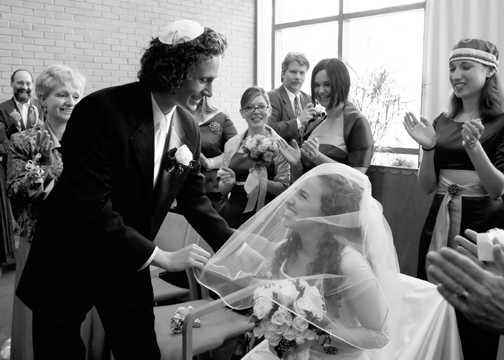
And this is why one of the oldest Jewish wedding traditions calls for a bedeken, or veiling. This ceremony occurs after the ketubah has been signed and before the chuppah portion. The groom approaches the bride and places the veil over her face to personally guarantee that yes, that is the face of the woman he intends to marry.

The bedeken ceremony is also a happy time! The bride sits in a throne-like chair and everyone around her dances and sings. The other women admire the bride for her beauty and offer her words of advice. Sounds like fun, right? A few umbrella drinks and a pedicure, and you have yourselves a real party!

The veil over the bride makes her “hekdesh,” which translate to, literally, “set apart in holiness.” Beauty may fade in time (although, future Chanukah presents to the bride’s self may be a lunch time trip to Dr. Botox…. shh, don’t tell), but a woman’s spiritual appreciation is a quality that never leaves. The veil physically separates the bride from the groom, which is a little way of noting that even in marriage, the two partners still remain unique, distinct individuals. Remembering this helps the couple work as a team as they aim for success in whatever they do.

Image courtesy of Stacy Newgent

Ketubah As Fine Art: Part II

Today is Part II of a 2-part series by Ketuv, the website behind fine art ketubahs. Yesterday, the ladies of Ketuv discussed the importance of personalizing ketubah art to fit a couple’s style, history, and home. Today, Part II is all about how to commission an artist to create your perfect memento of your marriage.

Whether you go with a Ketuv artist or not, here are some tips on choosing an artist and finding a style.

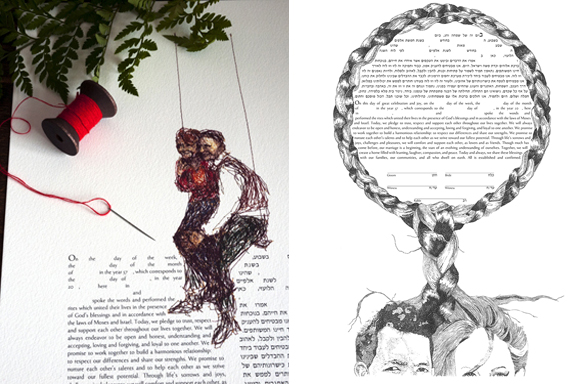
There is no special formula to finding the right artist. Look around. You don’t have to know about art to have an experience with it. When you like something, listen to yourself. Try to notice what about the work you like. Is it the color? The composition? The content? The medium (that is, what the artwork is actually made out of)?

Collect images of the artwork you and your partner like, and look at all the images together. Is there a pattern emerging? Are you finding that you’re more attracted to abstract work, or something more realistic? Are you finding that you like collage work, or pen and ink? Detailed work, or something simpler and more elegant? Colorful or black and white? Once you find your artist, these images and what you like about them will be invaluable information.

Remember, when you are considering commissioning a specific artist, you should imagine that your ketubah, while made especially with your ideas in mind, will look stylistically somewhat like the other work in the artist’s portfolio. That is, if you ask an abstract artist to draw a realistic portrait of you and your partner, it probably isn’t going to work out. When you like an artist, go with their strengths and you will get the best results.

Text
This can sometimes be the trickiest part about commissioning an artist to make your ketubah. At Ketuv, we feel that “ketubah artists” might not always fit the bill for the kind of artwork you’d like to hang in your home, which is why we created Ketuv in the first place. In our custom process, we take care of the text, and the artist takes care of the artwork.

If you’re going with an artist friend, or any artist that can’t provide the ketubah text, several ketubah companies, including Ketuv, offer text-only ketubot. You should also be aware that while many ketubah companies copyright their texts, Ketuv’s texts are open source and available for use, whether you work with us or not.

Communicate!
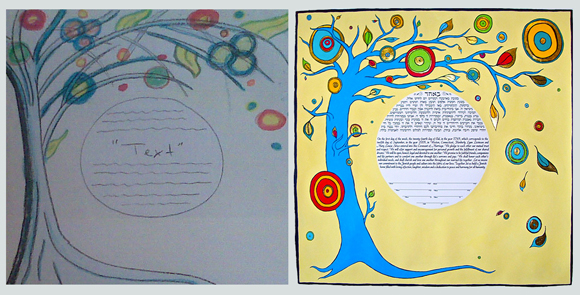
Let your artist in on the details of the conversation you had with your partner, and share your little folder of inspiration images, taking him/her through your vision for your ketubah. In one case, a couple even sent me a crude version of what they wanted, which they sketched out themselves in crayon!

Once you and the artist feel secure that you have come to an understanding regarding the content and style of your ketubah, you’ll have to hammer out the nuts and bolts:
1. The price of the artwork
2. How much time the artist will have to complete the artwork
3. How many updates the artist will provide for you before you receive the finished product (i.e. Will s/he have to send sketches? Photos of the work in progress? How many?)

Even if the artist is a friend, it might be best to write this down somewhere, just so everyone is clear.

This may sound like a lot of work, but we believe that you and your partner can figure out the basics of what you’re interested in over the span of a dedicated afternoon. It might also be fun, an opportunity to literally “visualize” your relationship. Don’t forget that your artist will also bring something to the table. You don’t have to have everything figured out in order to start the conversation!

What’s more, you’ll be investing in an heirloom, a symbol of your love that will stay in your family for generations.

———————-

Your love is unique. We think your ketubah should reflect that.

With the plethora of generic printed ketubahs available on the Internet, couples with a discerning eye have a hard time finding something that speaks to them. We formed Ketuv to provide couples with a fine art option in ketubahs, and to create an opportunity for innovative artists, with dynamic careers outside of the commercial and Judaica spheres, to create fresh, quality ketubah art.

Founded by artists Arielle Angel and Maya Joseph-Goteiner, Ketuv is committed to creating new opportunities for artists in the marketplace, with the ultimate goal of allowing artists to pursue their craft sustainably and with integrity.

Ketuv is also committed to honoring the diversity of the Jewish people, as well as people influenced by the Jewish tradition. While providing quality wedding and anniversary ketubahs for Jewish couples of all denominations, we also pride ourselves on offering progressive options in wedding artwork for same-sex, interfaith, non-denominational and non-Jewish couples.