Category Archives: Planning

4 Wedding Cake Trends We Love!

Designing your wedding dessert isn’t always a piece of cake!

You may be taste-testing for the best flavors and textures, but don’t forget about creating a work of art that wows your guests and stands out in photos. When and where else will a dessert be such a center piece than at your wedding reception? So take advantage of beautiful trends and ideas that showcase your cake with unique concepts and details.

Pearl Cakes
Nothing is more bridal than pearls. NOTHING! So, how much more weddingish can a wedding cake get? Pearly details! Whether included frosted beaded details or using frosting or fondant that has a pearly shimmer, this kind of cake is just about as elegant as it gets. Too pretty to eat? Yes! But… that’s not stopping anyone!

Pearl cakes

Wedding Cake Cakes
That’s right, plural cakes. Why have one when you can have more? Instead of one multi-tiered wedding cake, disassemble the tiers and display individual cakes. This plan takes up more cake real estate, making for a beautiful spread of confectionary goodness. That also means more opportunities for cute and creative cake toppers! By the way, speaking of cake toppers, don’t forget to add some bling to your spread with Bling Diva Designs. No one’s ever disliked a little sparkle, ya know?

Multiple Wedding Cakes

Rustic Cakes
Having a rustic wedding? It’s only natural to have a nature-themed cake. Nothing seals the theme more than a wedding cake to tie in the style of your day. And if you want to get all deep about it, your wedding day is the first day of new growth for a new family tree and you’ll those branches grow over the years. And the best part? The cake will look woodsy without tasting like wood!

Rustic Wedding Cakes

Non-cake Cakes
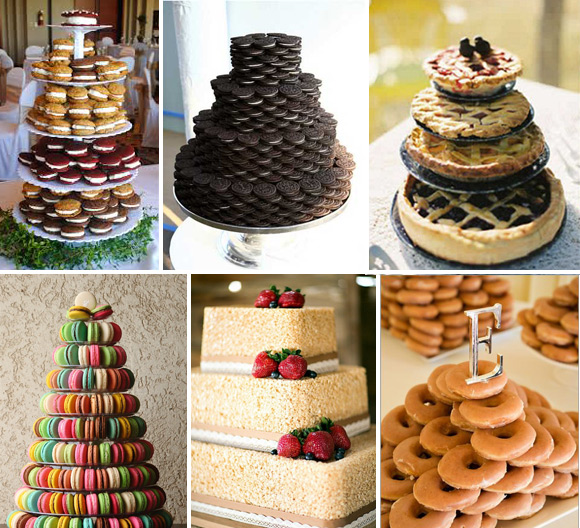
Who says you have to serve cake anyway? Choose to serve what you actually love. If it’s not cake, then think outside the cake box. Fruit pies! Donuts! Cookie cake! Rice Krispie Treats! Whoopie pies! Macarons! There’s no rule that mandates you serve traditional wedding cake. Find a baker and design your own dessert that represents your taste buds and style.

Alternative Wedding Cakes

Wedding Programs for Your Jewish or Interfaith Ceremony

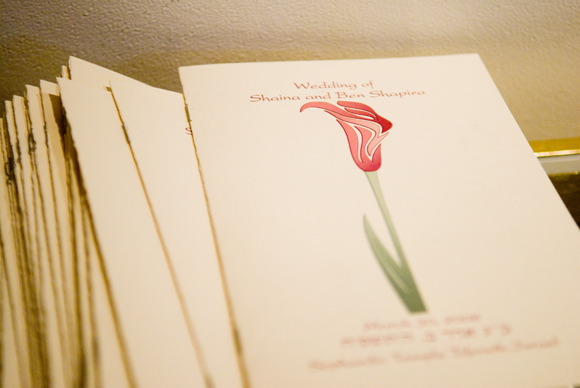
Are you providing programs for your guests? Programs are a great extra detail to create for your wedding ceremony. It’s a perfect place to welcome your friends and family, say thank you to those who made your wedding day possible, and even remember the loved ones who are no longer with you, but hold a special place in your heart and memory.

And, most importantly, it’s an ideal place to share some of the traditions your guests may see while you’re under the chuppah. Usually, a rabbi will lead the ceremony and describe what’s happening and why, but for those who want to take the program with them or if they missed the rabbi’s description, your friends and family can read about the beautiful traditions you’re including.

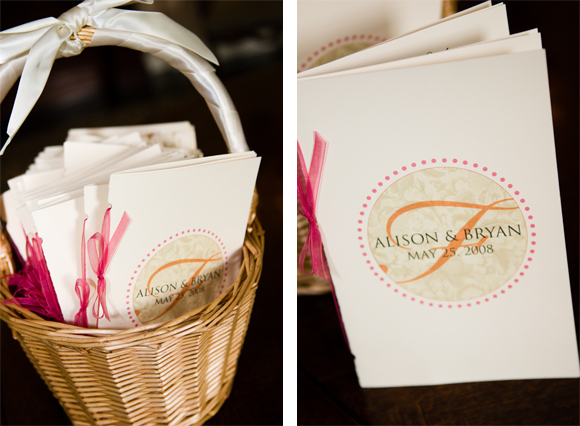
A typical wedding program will include the couple’s name, wedding date, and location on the cover. Inside, guests can usually find a welcome message from the couple, an ordered list of the people in the processional (officiant, parents, grandparents, bridal party, etc.), the order of the ceremony (this includes readings or songs and who will be performing them if it’s anyone other than the officiant), the traditions included throughout the day before, during, and after the ceremony, and an in memoriam-type of list.

This is a guide that has popular, mainstream Jewish traditions. If you are choosing to include other customs from another religion or culture, this would be a good place to add them. If your ceremony is more on the super reform side, you can tailor the wording and traditions listed below. And if you’re going ultra traditional, you’ll most likely need to add several more components. These selected traditions are from a modern, mainstream “conservaform” wedding and seem to follow the types of Jewish wedding ceremonies that visiting Yentas are designing. Feel free to “steal” what works for you and confirm with your officiant. It would be impossible to include every couple’s possible specific traditions and their “whys” and “hows” since all couples’ interpretation of Jewish weddings are different. So, I must reiterate, this is a skeleton, not a set-in-stone format.

Good luck! Email alison@theweddingyentas.com if you have additional questions!

Ketubah
The marriage contract (ketubah) specifies the couple’s commitment to each other. The ketubah was signed during a ceremony before the wedding service and contains the signatures of the bride and groom as well as two witnesses who are Jewish and not blood relatives. The rabbi has also signed and dated the ketubah to make it official.

Bedeken
The bedeken is the veiling ceremony during which the groom placed a veil over the bride. This ceremony took place privately and is considered one of the most moving elements of a traditional Jewish wedding. By covering his bride with a veil, the groom ascertained her identity, and confirmed that he is marrying the woman of his heart’s desire.

Chuppah
The chuppah is a canopy that symbolizes the home that the bride and groom will build together. The chuppah is open on all sides, also symbolizing that friends and family are always welcome in the newlyweds’ home.

Hakafot
The bride circles the groom (hakafot) seven times. Two interpretations of the significance: seven is the number of days of creation, and the wedding ceremony is the creation of a new household; seven is the number of times the phrase “when a man takes a wife” occurs in the Torah.

Wrapping the Tallit
During the final benediction, the couple is wrapped by a tallit (prayer shawl) around their shoulders. This wrapping symbolizes the private Jewish life the bride and groom will have together.

Breaking of the Glass
The wedding ceremony concludes with the groom breaking a glass under his foot. There are many significances behind this custom. One of them is that it is a reminder that relationships are as fragile as glass and must always be treated with care, love and respect. After the breaking of the glass, the guests yell, “Mazel Tov!” which means good luck.

Yichud
After the chuppah ceremony, the couple is escorted to a private room and left alone for a few minutes. These moments of seclusion signify their new status of living together as husband and wife.

Wedding Dress Shopping: A Fruity Approach

From-The-Expert

It’s so exciting to have an expert in the house! When it comes to dresses, Mill Crest Vintage knows their stuff! Personally, I’ve always loved antiques and historical items. I may not be a mathematician (when I hear “pi” I think pumpkin and apple), but I do know this: vintage styles + wedding = gorgeous! Today, Mill Crest Vintage is on board to tell us all about which kinds of dresses should go on various body types. Paula Cooperman, owner of Mill Crest Vintage, has spent three decades hand selecting each piece to add to her amazing collection of vintage bridal wear for both the traditional and non traditional bride, so she really knows about the potpourri of styles out there — from vintage to new — that do a body good! She has an amazing eye for detail and a great passion for finding what makes a woman feel the most beautiful on her wedding day. Offering personal and private bridal consultations in her Lambertville, New Jersey bridal salon, Paula has had the opportunity to work with hundreds of brides, gaining both experience and expertise in what goes into selecting a vintage wedding dresses and vintage bridesmaid dresses.
So the big day is almost here and you are now on the hunt for your wedding dress. You’ve scoured the magazines, surfed the web, and perhaps even taken pen to paper with your own designs in mind. Still, you have yet to find the dress that balances your (since you were 12 years old with a towel on your head running around the house singing “Here Comes The Bride”) dress of your dreams expectations, with the reality of your figure. While some very lucky gals out there can truly wear just about anything, the other 99% of us didn’t quite get the luck of the draw. Truth be told, it is not the size that matters (insert joke here) but instead, the shape. Yes lovelies, no matter what the scale says, figuring out one’s shape is much more important than one’s actual size. I hear ya! It’s about time someone finally focused on something other than the scale.

Seriously though, there is a good reason for all of this “figure out your figure” talk. The idea is to create the illusion of balance between the shoulder and the hip. Truthfully, this should be the ultimate goal for any woman when considering any dress. By determining one’s shape, a woman can determine which style of dress will balance out her figure best.

Here’s what we’re analyzing: pears, apples and squashes (yes, evidently squash is a fruit. Who knew?)

Ok, doll, time to get in front of a mirror and give yourself a good once over. Ask yourself: Am I shaped more like a pear (wider at the bottom than on the top)? How about an apple shape (wider in the middle than on top or bottom)? Perhaps I am shaped more like a squash (hourglass shaped)? Determining which fruit you most resemble will be the biggest and most important step in choosing the perfect dress.
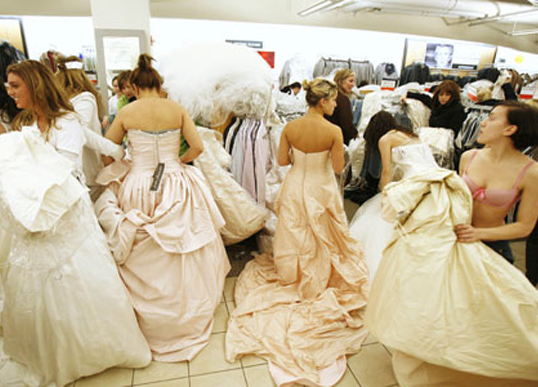
For you pear shaped gals, stick with A-line dresses, as well as, halter style dresses. A-line dresses look great on the pear shaped figure because the A-line dress is narrow at the top and flares gently at the base thus, drawing attention to the upper body, shoulders, and neck while disguising the wider hips and thighs. The halter top style dresses look great on a pear shaped body, too, especially because the desire is to flatter the bust and draw attention away from the problem area (the wider hip). Choose a halter style dress that nips in at the waist, and flares out into a wider skirt. Dresses with thin straps or one-asymmetrical shoulder also look great on the pear shaped figure. This allows the dress to drape over the body in such a way that the shoulder line and hip become more symmetrical with one another. Using detail at the shoulders and/or at the bust line helps to further balance the hip-to-shoulder ratio, giving the illusion of a minimized hip and a more hourglass shape.

For all the pears out there: There are also a few what-not-to-do recommendations. Considering the two styles of dresses recommended, pear shaped women should still avoid busy patterns and embellishments throughout the entire dress and instead opt for embellishments only in the bodice. Beads, ribbons, ruffles, and other decorations on the bust of a form fitting bodice should be chosen over embellishments in the skirt. Avoid tops that have narrow v-necks, heavily-gathered necklines, dolman sleeves and raglan sleeves, which can all reduce the width of your shoulders.

Ok apples, you’re up! For our yummy apple figured gals, empire waistlines are highly recommended. An empire dress in the right material works well to elongate the body, drawing attention away from the midsection, while still managing to show off the good curves. This style narrows at the top and flares slightly as it cascades toward the bottom, which is why it is flattering for apple figures. Choose a material like cotton or cotton blends, which will skim the body’s silhouette, and go for monochromatic color schemes. The illusion of the empire waist line enhances the curves of the bust and hip in such a way that balance is achieved, while the proper draping and the monochromatic color scheme offer a streamlined effect.

As we discussed, the benefit of an empire style dress for apple shaped figures is that it camouflages the midsection offering a slimming effect. However, there are a few things to avoid, such as ruffled shoulders or shoulders with padding. Do not wear dresses that feature a lot of busy detail especially near the waist, like ruffles, ruching, or other embellishments. This calls attention to the midsection, which is the area apple shapes usually try to minimize focus. Also, avoid any rounded flower corsages and instead opt for a corsage with cascading effects.

Finally we have arrived at our squashed shaped ladies. Apologies for referring to this sort of shape as a squash, but it is truly the only hourglass shaped fruit we could find. Hey, squash could have been easily swapped for gourd. But no woman I know would like to be referred to as a gourd. Moving on… As you may have guessed, women with ample bosoms and hips to match are considered hourglass shaped, like a squash. For this figure type, we recommend going with an A-line dress or a wrap dress, as long as the fabric drapes over the curves of the body without cinching or hugging. The idea is not exactly to reduce size, but instead to enhance the curves and achieve overall balance. These two styles of dress work best for this figure type because both of them cinch at the waist, while revealing the already balanced ratio between bust and hip. In other words, these two styles of dress complement the curves of the curvy hourglass shaped woman. For more full figured hourglass shaped gals, we also recommend V-cut necklines and some sleeve, even if only capped, to conceal any spill over from the bust.

Some don’ts for our beautiful squashes include dresses with a straight style and sleeveless dresses. Also, as some of us know, larger arms sometimes accompany a larger bust-line. Adornments and embellishments are fine, but avoid any at the arms, because too much “bling” at the arm can add width and throw off the balance of the body. On a side note, please be sure to wear a proper-fitting plus-size bra that gives the breasts optimal support when wearing any style.

Follow these guidelines and your Jewish wedding will star a beautiful bride in the most perfect dress!

So there it is in nutshell (wait… nuts?). Sorry. There it is in a fruit bowl: The fruity approach to wedding dress shopping.

How To Write Your Own Ketubah Text For Your Jewish Wedding

From-The-Expert
By Anna Abramzon of Anna Abramzon Studio

Ketubah text has been a hot topic lately, with the custom of a ketubah (or a decorative marital contract) becoming more and more popular among couples from all different backgrounds and faiths. A good way to think about your ketubah is as a “marriage” between visual art and written word. So, you found the perfect art that speaks to you, but what next? If you are getting married with an Orthodox or Conservative rabbi then the choice is easy, at least for the Hebrew portion of your ketubah — there is a standard Orthodox Aramaic text and what is known as the Conservative text with Lieberman Clause. If you have a rabbi from one of the more liberal movements then you have more decisions to make. Either way, most rabbis don’t mind if you pair the Hebrew or Aramaic with an English text of your choice, especially because the Orthodox and Conservative texts are pretty cut and dry. Ketubah websites and shops usually have a variety of texts for you to choose from, but what if none of them fully express what you want to say to each other? After all, it’s a very personal conversation between you and your fiancé!

Here are some tips for writing your own ketubah text:

The Basics:

A ketubah is a contract, so there is some information that it traditionally includes:

The date of the week of the wedding — if you are having the ceremony on a Saturday before sunset, some rabbis prefer that you list your wedding as Sunday so you are not getting married on Shabbat. This is something to check with your officiant.

The English date of the wedding

The Hebrew date of the wedding: remember, Hebrew days start at sunset, so if your chuppah is after sunset then you should list the next day’s Hebrew date. Here is a great site that will convert the date for you.

The location of the wedding: Definitely the city and state, some rabbis also like to add the country.

Your names and your parents’ names: traditionally the names are written in this form: “Jennifer daughter of Jacob and Elizabeth/Sam son of Michael and Rachel.” Of course whether or not you want to include the parents’ names is ultimately a decision for you and your rabbi. Most Orthodox rabbis prefer to just have the fathers’ names, while Conservative rabbis are often times more open to including both parents’ names.

A sample first paragraph of a ketubah text:

On the _________ day of the week, the _________ day of the month of _____________, corresponding to the __________ day of the month of ______________ in the year _________________, here in __________, ____________, the bride ________________ daughter of ____________ and ____________, and the groom ______________ son of _______________ and _____________, come together before family and friends to affirm their commitment to one another as partners in marriage.

Now the fun part:

Think of ketubah text as vows you are making to each other. A good way to get started is to brainstorm your values as a couple. Some good starting points: respect, kindness, support, love, faith, nurture. Do you plan to have kids? You can include some values for raising children, such as “we will pass on our values to our children”.

Don’t be afraid to get personal. Want your partner to bring you a glass of water before bed every night? Here’s your chance to get it in writing!

It’s OK to be funny. Some amazing clients of mine wrote a truly unique ketubah text that included that the bride “always gets a maid.” and “In return the (groom) will always have a microwave (lest he find himself stirring his oatmeal over an electric stove like some early-American pioneer);” Another favorite of mine was a couple who were both teachers and ended their text with “I vow to always be your greatest teacher.” Remember, that humor is never bad for a relationship and is as old a Jewish value as the 10 commandments. 😉

You can write the paragraphs as vows you are saying to each other:

“The bride and groom declared to one another: ….”

Or divide them:

“The bride, _______, said to the groom_________: ….”

“And the Groom,__________, promised his bride__________: …”

Be true to your spirituality: If religion is an important part of your lives, then by all means include that in your text. You can draw on biblical passages, or mention conditioning ancient traditions. But if religion is not your thing, then don’t feel pressured to mention it. This is your ketubah and it should reflect who you are as a couple.

Ask for help: If you get stumped, ask for help! Studying others’ ketubah texts can help you get ideas, but your rabbi, officiant, or ketubah artist could also be great resources. Remember, they deal with ketubahs all day long and you can’t beat that kind of experience!

Make it meaningful: When my husband and I were getting married, our rabbi said to us that engagement is like a microcosm of the rest of your lives together. You deal with all the big issues: budget, family, personal taste, etc., at once. Your ketubah text is a great opportunity to start a conversation and set a precedent for how you will work together as a couple.

Don’t forget to proof read: Because wouldn’t you hate to stare at a typo on your wall for the rest of your lives?

Enjoy the journey. Remember, your ketubah will stay with you forever, so let this process be a wonderful memory that accompanies you both into old age. Mazel tov!

AA1

***********************************

Anna Abramzon StudioToday, Anna Abramzon of Anna Abramzon Studio chimes in as a ketubah expert on The Wedding Yentas! They say she started drawing before she started walking, but that may be an exaggeration. As soon as she did start walking though, Anna started traveling, sketchbook in hand. She has lived all over the place and her travels have infused her artwork with color and life. Anna specialize in mixed media, combining collage with gouache, watercolor, pencil and ink. Anna met and married her husband in Jerusalem, Israel, and thought their wedding was a wonderful opportunity to create some love-inspired art, so she painted their ketubah, their invites, their thank you notes, and pretty much everything else that she possibly could for their wedding. Next thing she knew, other people started asking her to create artwork for their weddings. And that’s how Anna became a ketubah artist. She lives in Houston, Texas with her husband and daughter. Shop for your ketubah and keepsake art at Anna Abramzon Studio.

Wedding Reception Sweetheart Tables

You know how you have, like, 23897921 things to decide for your wedding? How’d you like one more?

“Where will you two be seated during your wedding reception?”

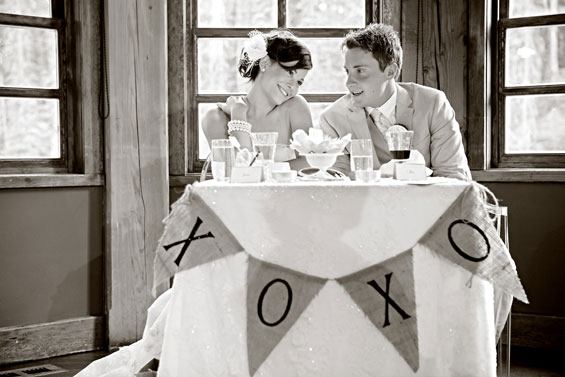
That question will lead you to consider a sweetheart table, a family table, a wedding party table, a periodic table of elements… Ok, hopefully not that last one (ew, I don’t do science). I don’t think there’s really a WRONG choice because I think all of the options have tons of pros and zero cons. But if you held up a box of fresh Scotchmallows in exchange for a decision on this subject, I would have to say that out of all of the options, I am a fan of the sweetheart table.

Why am I in favor of sweetheart tables?

Three reasons:

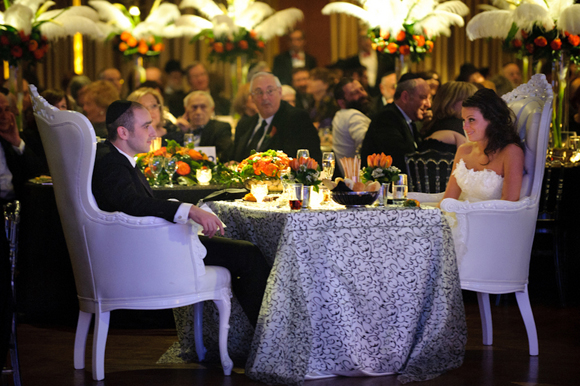
  • You have your own personal home base. You won’t be sitting much anyway, but when you are, it’ll be nice to have a little turf you can call your own. Your guests who want to offer you mazels and hugs know where to find you to have an intimate chat sometime between the salad and the entree. This takes some of the pressure off of you to have to get up and make the rounds in a small amount of time. People can come to you and they won’t mind.
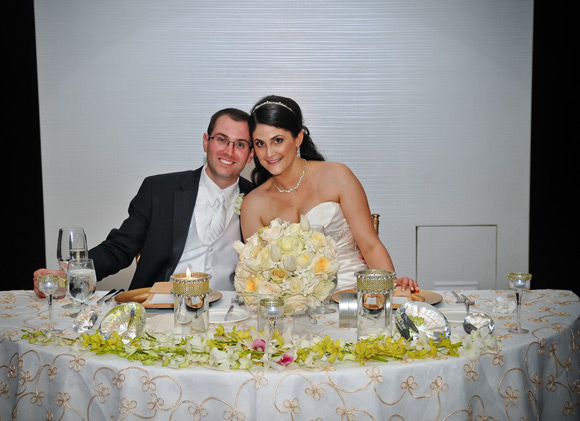
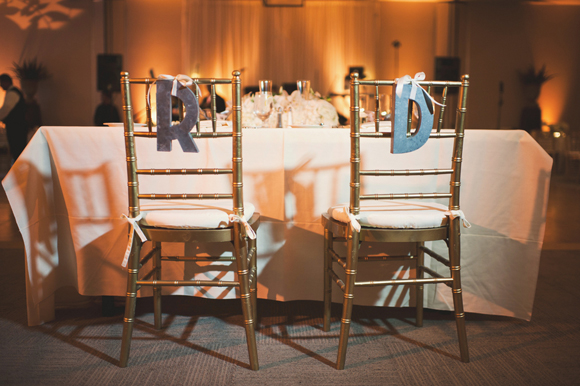
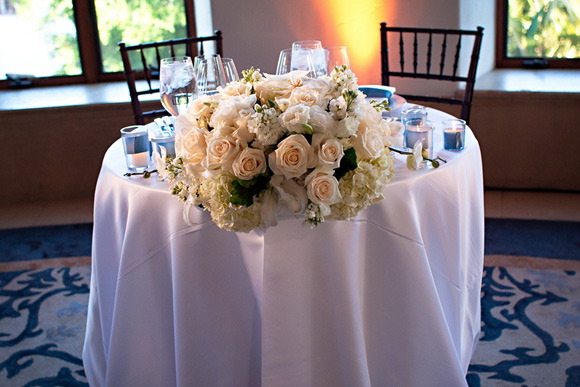
  • You’ll have another opportunity to extend your style. Props like “Mr.” & “Mrs.” signs, decked out chairs, or flower arrangements can furnish your sweetheart table, thereby making it a vehicle to tie in your theme, color scheme, or any additional design concepts.
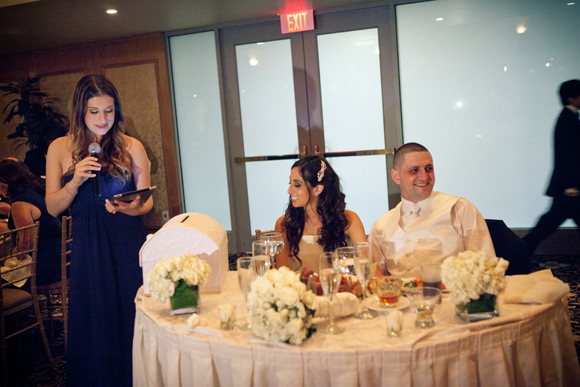
  • You get the best seat in the house! Normally, sweetheart tables are placed in front of the dance floor and in a position where you can look out and see all your guests surrounding you. If you are at a long banquet table with your bridal party, the placement of the table is not as flexible as a small, intimate table for two. Having the best seat in the reception hall is ideal during speeches, watching special dances, and generally taking it all in. You’ll be the focus of the reception area and why shouldn’t you be?

Photo by Orange Girl Photographs

However, it is important to make your sweetheart table tasteful. Setting it apart from the rest of the tables is fine; those few, subtle touches that declare the table special and unique to the bride and groom is totally acceptable. On the flip side, decking it out in gaudy drapery or an over abundance of flowers that make you look like Tarzan and Jane in the jungle is not the way to go.

Bottomline: The sweetheart table should complement the main tables, not appear to be out of place or swallow you up in the general world of your wedding reception ambiance.

Okay, I’m just going to leave it at that.

Moving on…

While it’s nice to have the home base of a sweetheart table, that also doesn’t take you off the hook of doing the right thing and making the rounds to see your guests. At a time that feels right for you (this is usually at some point during the salad or entree), you should really make sure you visit the tables to say hello and thanks to your guests. They will think you are both a lovely couple: a gracious bride and a mensch of a groom. The concept of you home base is to give you a semi-private place to enjoy each other’s company as newlyweds, but you should definitely not ignore your guests altogether.

Needs ideas for sweetheart table design? Look below for some sweet eye candy!

Stacy & Drew by Rosie Hernandez Photography

Desiree & Richard by Heidi Ryder Photography

Jackie & Danny by Photography by Verdi

Erica & Adi by Duke Photography

Jaynee & Sean by Mi Belle Photography

Serene & Mike by Ashleigh Taylor Photography

Naomi & Andrew by Phototerra