




We’re happy to host another knowledgeable guest blogger, Mindy Parker, who represents MP Artworks, the online ketubah design store that has unique and artistic prints for all couples’ tastes and styles. Today, we focus on selecting a ketubah for interfaith weddings. If only one of you is Jewish, are there additional rules that must be listed on your ketubah? What if your partner doesn’t want a very religious ketubah but accepts your Jewish roots? What if you’re a non-Jewish bride who knows nothing about planning a Jewish wedding, but you want your partner and partner’s family to feel included by incorporating their Jewish traditions? Mindy has all the answers for you here, so read on and know you have options!

Interfaith weddings can provide wonderful, yet challenging, opportunities to incorporate each other’s traditions into the celebration. Some things, such as the ketubah – one of the traditions (in fact, requirements) of a Jewish wedding – happens to translate very nicely to an interfaith setting. And because it’s often the one thing that you will hang on your wall and see day after day, long after you say “I do,” it’s well worth considering. So let me quickly demystify what an “interfaith ketubah” is and then tell you what to look for to get you started.
The first question is usually, “What exactly is an interfaith ketubah anyway?” This one is easy. There is no “standard” or “official” interfaith ketubah. There’s just no such thing. The term simply means a ketubah (or, traditionally, a Jewish marriage contract) in which the design and the text are geared toward an interfaith couple. These days there are plenty of options available for interfaith couples, so let me give you some quick pointers.
I’ll start with the “interfaith” design. As a Jewish tradition, you will find that many ketubahs have Jewish symbolism, which you may want to avoid. For example, many designs incorporate the Star of David or Jewish scripture. But worry not – there are many, many ketubahs that are simply beautiful works of art with no religious symbolism whatsoever. In fact, this is the fun part! Designs range from traditional to funky, simple to elaborate, impressionistic to pop art, in every color scheme possible. There are many designs that even incorporate other cultures’ symbolism or art, which is a great way to “represent” the non-Jewish party in this tradition. Remember, this is a work of art that you will probably be staring at for the next 50 (at least) years on your wall so you want to choose a design that you both truly love.

Next, you will want to choose an “interfaith” text. The only “standard” ketubah text is the original Aramaic text, still used today with little change by the Orthodox and Conservative movements. Beyond that, most other texts are simply written by the ketubah artist who almost always offers one or more “interfaith” texts. They are not legal contracts but simply modern, egalitarian statements of your vows to each other. But you will find that an “interfaith” text will also exclude any religious or cultural language that could be offensive to the non-Jewish party, such as references to Moses, Sarah, Israel or such Jewish-oriented phrases as “home built on Torah” or “traditional Jewish spirit.” An interfaith ketubah text, like most ketubah texts in America, typically contains two portions: one in English and one in Hebrew. The Hebrew is a direct translation of the English and gives the Jewish party an opportunity to recognize their Jewish background. But if you prefer, you can choose to have an English-only ketubah, or you may want to write your own custom text to reflect exactly what’s important to you.
If a rabbi or cantor will be officiating at your ceremony, it is a good idea to have him or her approve the text. Although an interfaith ketubah is not a legal document according to Jewish law, some officiants still have strict policies about what kind of text they will (or will not) allow on an interfaith ketubah. Remember that all officiants are different, and since your officiant is the final authority on what is permitted at your wedding, you definitely want to know ahead of time if your text selection will be permitted.
Perhaps the most confusion comes when you need to personalize your interfaith text – i.e., provide the information to fill in the blanks with your names, dates, location, etc. But it’s actually quite simple. If the Jewish partner has a given Hebrew name, it is customary to use it on the ketubah, in conjunction with the parents’ Hebrew names. Then comes the tricky part. The single most often-asked interfaith ketubah text question: “My fiance is not Jewish; how do we handle the Hebrew names on that side?” There are two possible answers to this question: (1) You can omit the non-Jewish people from the text or, (2) My personal preference, allow the non-Jewish names to be transliterated. Relax, no one is getting a “Hebrew” name here. Instead, the names are simply spelled out, phonetically, in Hebrew characters (like spelling an Israeli name in English letters). This process ensures that all people within both texts have been included, resulting in a “balanced” ketubah.
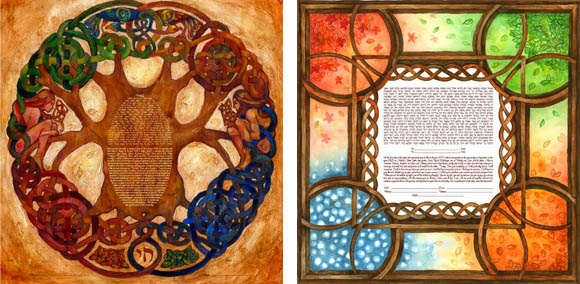
There may be some “extras” you might want depending on your circumstance and what your ketubah artist offers. For example, if the non-Jewish partner is Irish, you might want to add a third language and have your ketubah text in English, Hebrew and Gaelic. Or if you are having your ceremony performed jointly by a rabbi and a minister, you may want to alter the ketubah’s signature lines to add one for the minister. Be sure to talk to your ketubah artist or the shop where you get your ketubah to see what other options might be right for you.
That’s basically it! Choose your favorite design, select the text that works best for you, then personalize it. That’s all you need to do to have an interfaith ketubah that will incorporate the Jewish tradition yet serve as a beautiful memento of your special day.
 Mindy K. Parker is the co-founder of Ketubah Studio by MP Artworks – “The Ketubah People.” She works on the business side of the company with fine artists exclusively represented by Ketubah Studio, and serves as inspiration for her co-founder husband, Micah, the principal artist and creative visionary. Together, they love working with couples of all ages, backgrounds and religions to provide them with unique designs that show off their style. When she’s not working, she’s likely covered in pet hair from their artistic cats (Monet, Matisse, Pollock and Seuss) and musical pit bull (Redbone) or other animals that she volunteers with at local shelters.


