Category Archives: Planning

WIN A KETUBAH!

All month long, you will have your chance to enter to win a ketubah from the lovely folks at MP Artworks! February is the month of loooooove and since a ketubah is the Jewish marriage contract that’s signed on the day of your wedding, it seems perfect to offer you this amazing prize with chances to enter and vote for a winner through the end of the month!

So, here’s how it works:

From now until Thursday, February 16th at 11:59 p.m. PST, you can submit a photo of a deserving couple. This can be you and your partner, your friends, your son and his fiance — anyone who is engaged and needs a ketubah! Include the couple’s names, their wedding date, and e-mail your photo to alison@theweddingyentas.com by the deadline to be included in the contest. Eligibility allows for only one photo submission per couple.

Voting takes place from Friday, February 17th through Wednesday, February 29th. Any other year, and we would have one less day to vote in February. Take advantage of this extra day! Voting works by leaving a comment on the TBA page with all of the photos of the candidates. The comment should include the name of the couple that the voter would like to win and a reason why. “I vote for Isaac and Rebecca because they are a generous and patient couple!” For extra votes, you can “like” the MP Artworks Facebook page and leave a comment on the wall and “like” The Wedding Yentas Facebook page and leave a comment on the wall. Each comment is equal to one entry for a total of three (two Facebooks and the main page). The photo/couple with the most amount of total votes wins the ketubah prize!

The winner will be announced on Thursday, March 1st!

The winning couple receives $300 to MP Artworks! In most cases, depending on the ketubah the couple selects, this may mean a free ketubah and personalization!

Good luck!!

Breakdown:

  • February 1 through February 16: Submit photos to alison@theweddingyentas.com
  • February 17 through February 29: Voting begins and continues
  • March 1: Winner announced

Fine print: Your wedding must be no sooner than four weeks from Thursday, March 1st to guarantee on-time arrival of your ketubah if you win the giveaway from The Wedding Yentas and MP Artworks. One submission per couple maximum.

A Groom with Sass Steps on the Glass

Crunch.
Smash.
Stomp.
Boom.
Bang.
Crash.
Crush.

These are the sounds everyone wants to hear when the groom steps on the glass at his Jewish wedding. What a yummy and satisfying sound and it elicits such a hearty “mazel tov!” from all those in attendance. And bookended by kisses? Yeah, what’s not to love about the breaking of the glass?!

The question is: Can breaking the glass become any more exciting than it already is? The answer is YES. Yes, it can.

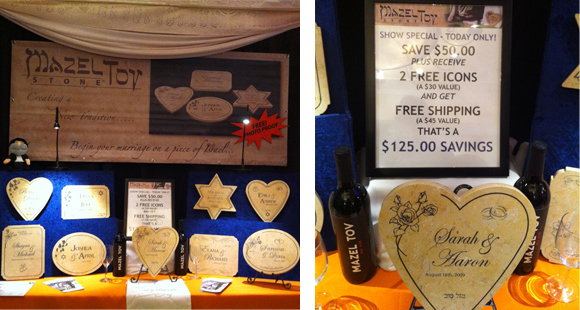
Thanks to Mazel Tov Stone, the groom has a ceremony memento that provides a sturdy and volume-increasing surface for the glass to break on with a rapid and swift stomp of the foot. Want even more bang for your buck? The pro tip: Use the heel of the foot for maximum crunch.

A Mazel Tov Stone does more than its job under the chuppah during the ceremony. It also serves as a beautiful keepsake of your wedding because it’s personalized with your information. You have a ketubah as a special symbol of your wedding day, right? A Mazel Tov Stone is another artifact from the happiest day of your life that can live in your home for all the years after.

A few weeks ago, I got to hang out with Robb and Lisa — the genius husband-and-wife team behind Mazel Tov Stone — at Bridal Premiere in California.

It’s always so fun to see friends of The Wedding Yentas in person. To all the rest of the fabulous friends in The Wedding Yentas Vendor Directory, let’s plan a big, flashy party so we can all get together and gush about our favorite thing: Jewish weddings!

Anyway, Mazel Tov Stone set up a picture-perfect booth to complement their beautiful stones and offered real demos of glass-breaking galore. They were also offering a bridal show special on their pricing. Teeeeeeechnically, it was an offer for people who were there that day and that day only. But, because you’re a reader of The Wedding Yentas, mention the bridal show special and you might luck out in the savings department. Wink, wink.

It was so fun to watch all kinds of grooms take a shot at breaking the glass. Even when it’s not a real wedding, there’s something so contagiously happy about it!

What IS a Junior Bridesmaid Anyway?

Your younger, but not thaaaaat much younger cousin whose hair you used to french braid for dance class every Thursday. The cute girls down the street who considered you their favorite babysitter when they were tiny and you used to gossip with their mom after she’d come home from work. Your fiance’s only niece and the other cute girl in his life who takes him up on every offer for a piggy back ride and tea party. None of these girls are young enough to be the toddling and cute-but-clueless flower girl who walks down the aisle. But they’re also not old enough to be a bridesmaid who can do and afford all of the bridesmaid-y events. So, you have an epiphany and say to yourself, “Self! I know! [Insert Name Here] can be a JUNIOR BRIDESMAID!”

Genius idea, but what the blintzes does a junior bridesmaid even do?

Well, a junior bridesmaid is like a watered down version of an adult bridesmaid and a totally upgraded model of a flower girl. She’s cute and gets time to shine like a flower girl, but fits in more with the adult bridesmaids. Best of both worlds, right?

Usually, the over/under for the age of a junior bridesmaid is between 9 and 14. None of the traditions are requirements, but you can take what you need and make up your own rules about how to include your junior bridesmaid on your wedding day.

Because a junior bridesmaid is not, like, working for The Man, she probably has no income to throw you a shower. Unless your junior bridesmaid is Dakota Fanning. Wait, I think she’s older than 14 now. But you know what I mean. So, even though she won’t dish out cash to help sponsor the shower, she should be included by planning to attend and assist with bridal shower duties like set-up and clean-up, making favors, cooking and baking, helping with gifts, and other very important tasks.

You can even include your junior bridesmaid when you go wedding gown shopping. Now, you are not required to follow her opinions or let her pick out The Dress, but certainly she can be there as part of the experience. This is really more appropriate if your junior bridesmaid is a sister or a daughter, but it’s a nice and special way to include her. And she’ll love all the pretty dresses!

Speaking of dresses, she’ll get to wear a similar, if not the same, dress as the bridesmaids! Sometimes, brides select a dress for the junior bridesmaid that may be a bit longer in length or something with straps. It can be the same fabric and color as the adult bridesmaids, but if your gals are sporting a sexy dress, nothing says “tacky wedding” like allowing the junior bridesmaid to wear the identical frock. So, you know, good judgement yada yada yada.

She can also hold a smaller version of the adult bridesmaids’ bouquet. There’s always the corsage option, but that’s a little too prom for my personal taste. Most would agree.

When it comes to the wedding events, the junior bridesmaid will be at your rehearsal dinner like the rest of the bridal party and she can also hang with the ushers (what younger girl wouldn’t want to rub elbows with cool, older, cute guys in suits?) by also seating guests, handing out programs, or standing by the yarmulkes. She’ll definitely charm the old Jewish men that way.

Your junior bridesmaid can walk alone down the aisle, with another young man (junior groomsman?), or with another adult member of the wedding party. No rule here. It’s up to you and how symmetrical you are in your planning.

Just keep in mind — and this is a reminder because most of us have tried to forget — that your junior bridesmaid might be going through the, you know, change. Puberty. So, when it comes to picking out her look for day, be cognizant of the fact that she might be self-conscious or unable to pull off the style you have in mind. Remember when we were figuring it all out? Yeah, that’s probably what she’s going through right now. She might be brushing her curls… not something I ever did. No, no. I would have never done that because it causes really annoying frizzy hair, which makes awkward pubescent years even more traumatic. Sigh.

So, even though she may be a wee bit underage to join you for your bachelorette party at Guido’s Chippendales, your favorite younger gal pal can experience your bridal experience in a more G-rated fashion. She’ll be honored to be by your side as you say “I do” to your love, and maybe even learn a thing or to about how to be the coolest bride ever for when it’s her turn in 15-ish years.

Dating a Wedding Date

Every Yenta (not just us) will ask you, “So? When’s the date?” You take another bite of brisket and swallow hard. You’re not sure how to answer. You haven’t picked a date yet.

Every member of your mother’s temple sisterhood is hounding you for the date and you haven’t figured it out, but you’re feeling pressured, and you still need to do more research because once the date is locked in, it’s a done deal, so you reach and reach for an answer to give her but she’s still staring at you, expecting an answer so even though you’re picturing yourself in a strapless, flirty tea-length wedding dress standing under a chuppah adorned with pink and cream peonies, you’re not sure when those flowers are in season, so it really depends on the date you get married, and oh gosh, she’s still waiting and she has a chunk of mascara dangling from her left eyelash and now that’s all you can think about so you just blurt out: “We don’t know yet.”

There it is. That look of disapproval. HOW CAN YOU NOT KNOW YET?

There are tons of reasons!

Early on in the site’s young life, we provided you a list of holiday weekends for Sunday night weddings over the next 3 years. But what if you have questions that span outside the no-weddings-on-Shabbat rule? What if there are other holidays or mourning periods that come up while you’re trying to plan your wedding and set a date? Jewish marriages are not to be performed during points throughout a year, and we are here to help explain these calendar crossovers.

RELIGIOUS RESTRICTIONS
There are no weddings on:
The Sabbath (Friday to Saturday 30 minutes after sundown).

The major holidays; you know, the usuals: Rosh Hashanah, Yom Kippur, Passover, Shavuot, and Sukkot (sundown to sundown). Basically, every holiday you probably celebrated or heavily discussed at Hebrew school (though you may not remember because you were distracted with the happy possibility of being invited to Seth Silverstein’s Bar Mitzvah where you may be able to play Pepsi-7up and sit on his knee).

Orthodox and conservative congregations also don’t permit weddings during The “Three Weeks” (which are the 17th of Tammuz to the 9th of Av, which usually fall in July and August) and the Sefirah period (these are the 7 weeks between Passover and Shavuot, except for the holiday of Lag b’Omer, which is usually in April and May).
These times are actually considered national mourning periods due to historical tragedies such as the destruction of the Temple and a plague that forced its way through the greatest and noblest scholars of the time.

And, this brings us to the reason why June is the most popular time of year for a not-too-hot, not-too-cold wedding.

PERSONAL MOURNING PERIODS
If you and your husband-to-be are in mourning, then you can’t secure a wedding date during the 30 days of mourning that are typically reserved for a brother or sister. Additionally, you can’t plan a wedding date during the 11 months observed for a mother or father. Reform practitioners usually go with the 30 day rule for any kind of mourning period. If you’re unsure, the usual Wedding Yentas disclaimer applies: Ask your rabbi.

However, if the date has already been set, you may not postpone a wedding even if there is a death (pooh pooh) in the family. Rabbis say that a marriage is the highest of mitzvot and even mourning is not allowed to interfere with such a wonderful occasion. The wedding should go on as scheduled, but personal decisions may be made about scaling down the festive atmosphere. Again, can I get a giant bubbie-style “pooh pooh” and 3 spits please? Thank you.

PERSONAL PONDERINGS
Here’s the part where you check your own calendar to make sure you don’t make a big uh-oh on top of the Jewish practices. What kinds of flowers do you want? If you want harvest symbols or chrysanthemums, you might like to be a Fall bride. Tulips and dahlias make you a perfect picture of a Spring bride. Do you have a special date like your dating anniversary or honoring a relative’s wedding date? Do you need to make sure other occasions aren’t close to your wedding date because of your sister’s graduation or your brother-in-law’s leave from the military? Is there another family wedding that might conflict with your ideal date?

Remember this bit of important wedding advice: You won’t be able to please everybody. Follow the Jewish laws as you see fit and steer clear of personal conflicts. As long as your most favorite people are there to witness you and your groom get married, your special day will still be the happiest.

Tick Tock to the Simcha: Part II

On Monday, we brought you Part I of the time line we suggest you follow while planning your wedding. Today, we continue where we left off and hope that the complete time line brings you peace of mind and excitement to the wedding planning process!

2 Months Before

  • It’s time to order your yarmulkes. To personalize them, complete the order with your names and wedding date so guests have a memento of your day. This can be your Hebrew names and Hebrew date or your daily names and modern date. Consider the fabrics you’d like (shiny, suede, etc.) and color (black, white, blue, etc.) Something to think about when it comes to yarmulkes: in photos from the back of the ceremony, white or beige yarmulkes can make it appear as though all your male guests are bald. If you’re not married to a specific color, perhaps you might order blue, brown, or black yarmulkes since they are dark and will match most men’s hair.
  • If you chose to book an aurfruf, start learning the Hebrew blessings. This could be anything from simple blessings before and after the Torah reading or more elaborate prayers. Check with your temple and rabbi.
  • Order programs and benchers (prayer booklets) for your ceremony if you are including them for your guests. We believe that it is helpful to have programs available during your ceremony so that non-Jewish guests have the opportunity to understand the beautiful rituals and symbols of the Jewish wedding. You can order these premade, or you can design your own. We recommend designing and printing your own because it can be a fun project for you and your fiance to complete together!

jewish-wedding-program

6 Weeks Before

  • If you are choosing to visit a mikvah (ritual bath), you should make arrangements for this event now. Also, you may plan a small party to follow the mikvah. This is a very traditional and beautiful Jewish event for a bride. Depending on your movement of Judaism, you may or may not plan to do this.
  • Finalize any last minute vendors. Perhaps you decided after all to hire a videographer or to rent chair covers. This is probably the last chance you’ll have before you’re out of luck. Make sure to assess your vendor list and check off finished business.
  • Make sure you’ve had a food tasting by now with your venue or caterer. This fun wedding-planning moment will give you an idea of what to expect on your wedding day. Giving your venue or caterer enough time to plan the menu for your day is key.
  • Practice makes…pretty! Now is the time to meet with your hair stylist and make up artist – either together or separately – to have a trial of your wedding day look. Your hair should be grown out to the approximate wedding-day length by now and you should have an idea of what you want your makeup to look like. Bring magazine photos, hair accessories, and a clean face.

3 to 4 Weeks Before

  • Meet with your officiant one last time to go over the ceremony.
  • Make sure that those who are participating in the ceremony understand what is involved (this is especially true if you are not having a rehearsal).

1 to 2 Weeks Before

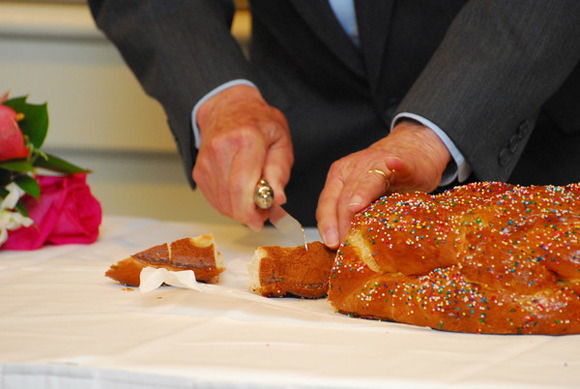
  • Remind your caterer to order ritual foods like the challah, wine, and any other needed items. If you’re not ordering from your caterer, make sure to secure these items on your own or through other vendors. Challahs need to be special ordered for a party the size of an average wedding and you want to make sure you’ve selected your Kosher wine.
  • Provide your wedding party with a breakdown of the wedding day and a time line of the wedding weekend so that everyone is on the same page about the times and locations of the festivities.

1 Day Before

  • Hand over the important and valuable items to someone reliable who will also be near you and your partner the day of the wedding. This person, usually the Best Man, will have the rings, papers with vows, and any other items necessary for the ceremony.
  • Depending on your venue’s contract, you may be able to “move in” the day before your wedding. On this day, bring all items you’ll need for your ceremony (ketubah, easel, pens, glass, wine, etc.) and for your reception (candles, table numbers, favors, escort cards, etc). Obviously you and your venue must be in agreement about this, but we suggest you pack ceremony things and reception things into boxes for ultimate organization and an easy “move in” day.

There you have it: A basic time line for a Jewish wedding. Now, there are zillions of other things you need to check off your list as the time tick-tocks away, and we’ll cover more specific items in the future. Use this as a reference to make sure you’re on the right track. Specific vendors and couples require slightly different variations of this time line, but we hope to get your mind jogging and headed toward the right direction: happy, wedded bliss!